Bass Fishing in the Rain: A Practical Guide to Changing Conditions
Rain changes light, surface disturbance, runoff and angler safety, but it does not guarantee a bite. Use this practical framework to decide where to fish, what to change and when to call it.
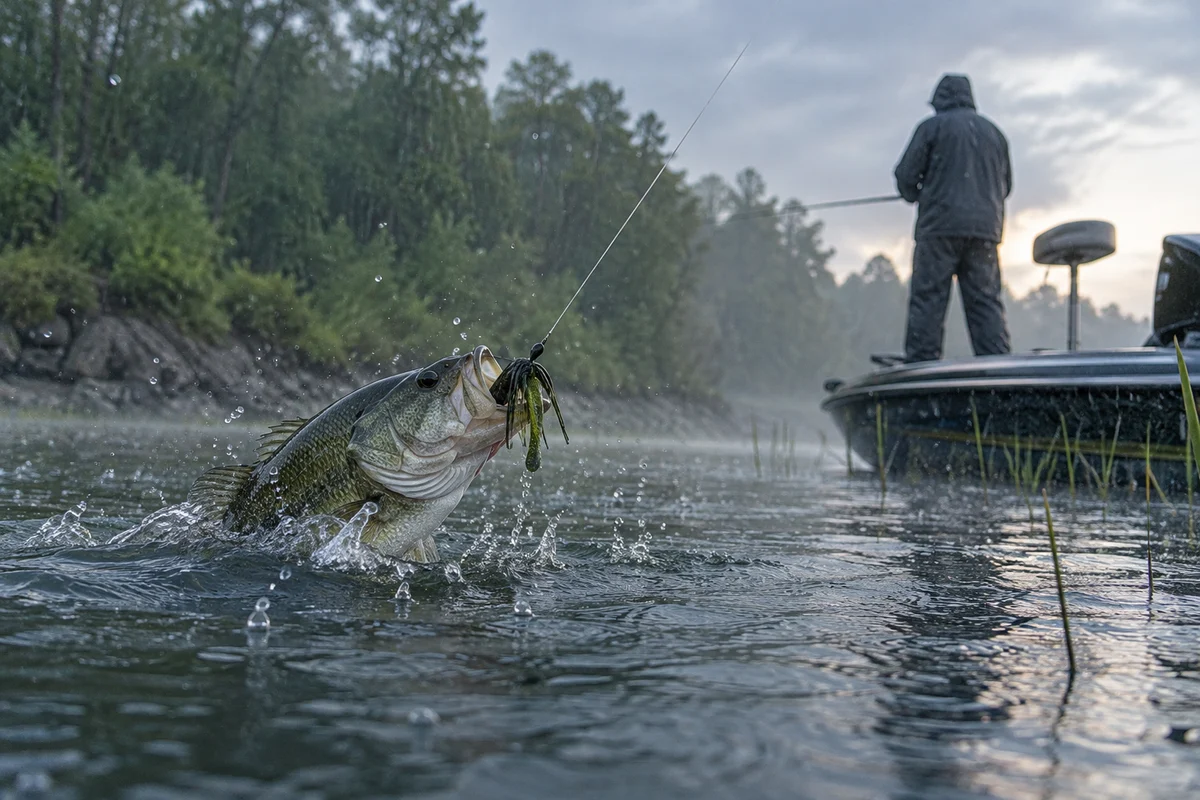
Rain can make bass fishing feel full of possibility: the surface breaks up, shorelines grow quieter, and a lake may seem newly alive. But bass fishing in the rain is not a dependable shortcut to a limit. A passing shower, a cold front, a warm summer storm and prolonged runoff create different conditions. The useful question is not simply whether it is raining, but what the rain is doing to light, wind, water clarity and fishable access.
Start by checking the forecast, water conditions and any local advisories. If thunder is audible or lightning is nearby, leave the water and seek substantial shelter; a boat, dock or isolated tree is not a safe refuge. For more foundational strategy, see our guide to bass fishing for beginners. Then use the conditions—not a fixed lure recipe—to make a plan.
What rain changes for bass
Rain can reduce overhead light and add surface disturbance. Those changes may make bass more willing to roam or feed in shallow water, especially when baitfish or other forage are already present. Wind-driven waves can also push food toward a bank, point or other windward area. That is a possibility, not a rule: wind direction, shoreline shape, cover, season and the lake’s forage all matter.
Rain also changes what you can see and feel. Falling drops and waves make it harder to spot subtle line movement, judge a lure’s action or maintain boat position. Runoff can carry soil and debris into creeks and coves. The result may be a narrow band of stained water beside clearer water, or a broad area that becomes difficult to fish effectively.
Think of rain as a set of conditions to diagnose. Is the water merely dimpled, or are waves making boat control unsafe? Is a creek mouth bringing in slightly stained water, or a fast, muddy flow full of floating debris? Those differences should guide your choices more than the word “rain” in the forecast.
A quick decision framework
| What you observe | First adjustment | What to watch next |
|---|---|---|
| Light rain, manageable wind, stable water | Cover a bank or point with visible cover and nearby depth | Whether bait, bites or surface activity appear |
| Wind pushes waves onto a bank | Try the protected edges and nearby points, keeping boat control in mind | Whether the wind is moving forage or simply making the area hard to fish |
| A small runoff plume enters clearer water | Check the edge where water colors meet, from a safe position | Current strength, floating debris and whether clarity is changing |
| Water becomes broadly muddy or rises quickly | Slow down, prioritize recognizable cover and reassess location | Visibility, current, rising water and access routes |
| Thunder, lightning, unsafe waves or rapidly rising water | Stop fishing and move to appropriate shelter or safe ground | Official weather and water advisories before resuming |
Use the table as a starting point rather than a promise of results. The best option may be to leave a tempting bank alone if wind, current or visibility makes it unsafe.
Where to look: cover, edges and nearby depth
In light rain, begin with places that combine cover and an escape route to deeper water: a point, a dock edge, a weedline, a laydown or a shallow flat beside a channel. Make a few deliberate casts before moving. A fish may use the shallow side to feed and retreat to nearby depth, but the exact position changes with season and local conditions.
Wind can concentrate opportunity, but do not automatically fish the most exposed shore. If waves are pushing into a bank, look for a manageable stretch where the bank, a point or vegetation gives you a controlled casting angle. If the boat cannot hold position or the waves make casting and landing a fish hazardous, choose a sheltered area or end the outing.
After runoff, inspect the water transition rather than assuming the muddiest water is best. A bass may hold near the edge of a plume, where visibility and available forage differ from the inflow. Avoid fast, debris-laden water, and do not wade into water whose depth, footing or current you cannot assess. Heavy rain can change a familiar access point quickly.
Choose a presentation you can control
There is no universally correct rainy-day lure. Pick something you can keep in the productive zone and detect despite wind and surface noise. In shallow cover, a moving bait may help you cover water; around isolated targets, a slower presentation can give you more control. If visibility is limited, consider a profile or vibration you can track, then test it rather than assuming fish will respond.
A soft plastic is useful when you want to work a specific piece of cover at a measured pace. Review our overview of plastic worm rigs for bass for rigging concepts, and adjust the weight and approach to the cover and local rules. If bass are using vegetation or another shallow edge, a swimming jig can be a search option; our article on swimming jigs for bass discusses the general presentation. Those links are starting points, not endorsements or guarantees, and tackle availability and designs can change.
Keep changes simple. Begin with a location and presentation you can fish safely. If you see no signs of activity, alter one variable at a time: move to a nearby depth change, slow the retrieve, or switch to a presentation that is easier to feel. Changing location, lure, speed and color all at once makes it difficult to learn what the conditions are telling you.
Reading the water as the rain continues
Watch the shoreline and your line, not only the sky. Note whether water is rising, whether the color is changing, and whether wind is strengthening. Look for bait movement, surface disturbances or fish activity, while remembering that rain itself can create misleading surface rings. A few minutes of observation before making repeated casts can save time.
If a creek or drainage is flowing, treat it as both a fishing feature and a hazard. Water can carry branches, trash and other objects, while current and depth may change without warning. Do not position a boat in a narrow flow simply because it appears to funnel forage. Keep clear of obstructions and maintain a route back to a safe launch or shore.
When the rain stops, conditions may keep changing. Runoff can continue to enter the lake, and wind can persist after the shower passes. Recheck clarity and access rather than assuming the end of rainfall means the water has returned to normal.
Safety is part of the fishing plan
Lightning is an immediate reason to stop. Follow local weather alerts, head for substantial shelter well before a storm reaches you, and wait until the storm has passed according to official guidance. A fishing rod, open shoreline or boat offers no protection. If you are on the water, do not wait for a close strike to make a decision.
Rain can also reduce visibility for boat operators and make ramps, rocks, banks and docks slippery. Wear a properly fitted life jacket while boating, keep essential equipment accessible, and tell someone where you plan to fish and when you expect to return. Follow boating and access rules for your location. If wind, waves, cold, current or rising water make the outing difficult to manage, turn back. There is no catch worth taking an avoidable risk.
A practical rainy-day checklist
- Check weather alerts, wind, temperature and local water or access advisories before leaving.
- Choose a sheltered backup location and a clear point at which you will stop fishing.
- Secure loose gear and carry rain protection that does not interfere with safe movement.
- Keep casts and boat movement within conditions you can control.
- Reassess water color, current, debris and access as the outing progresses.
- Leave immediately for safe shelter if thunder or lightning threatens.
The best rainy-day adjustment is often a decision, not a lure change. When conditions are stable and safe, rain may offer a different look at familiar cover. When weather or runoff becomes hazardous, the right move is to stop.
The takeaway
Rain can create useful opportunities by changing light, surface conditions and the movement of water, but it does not make bass predictable. Fish manageable cover and water transitions, choose a presentation you can control, change one factor at a time, and let safety determine where—and whether—you continue.
For more, explore our bass fishing fishing freshwater guides.
Frequently asked questions
Do bass bite better in the rain?
Sometimes, but rain is not a guarantee. Light, wind, water clarity, season and forage all influence bass activity, so observe conditions and adjust.
Where should I fish after rain runoff enters a lake?
If conditions are safe, inspect the edge between runoff-stained and clearer water near cover. Avoid fast current, floating debris and rapidly rising water.
What should I throw for bass in the rain?
Choose a presentation you can control and detect in the wind and surface disturbance. A moving bait can cover water; a soft plastic can work a specific target. Neither is universally best.
Is it safe to fish during a thunderstorm?
No. Stop fishing and seek substantial shelter when thunder or lightning threatens. Follow official weather guidance before returning to the water.
Sources & further information
Consult these primary sources for current regulations, technical information and local guidance.