Where Was the Florida State Record Bass Caught? Start With the Species
Florida bass records are species-specific, so a useful location answer starts by identifying which bass and record category a claim refers to. Here’s how to check the current official listing and interpret a reported catch without repeating an unverified headline.
Where was the Florida state record bass caught?
The question “where was the Florida state record bass caught” needs one clarification before a place can be named: which bass species and which record category? Florida has several freshwater bass species, and a record for shoal bass is not the same record as one for largemouth bass. State records can also be updated, so a place repeated in an old headline may not describe the current listing.
For a dependable answer, check the Florida Fish and Wildlife Conservation Commission’s current freshwater fishing records and read the entry for the exact species. Use the waterbody or location stated there, along with any county or catch details the agency provides. If an article says only “state-record bass,” or refers to a “new record” without naming the category, it does not provide enough information to identify a verified location.
That distinction matters for Florida anglers, where a conversation about a famous largemouth catch can easily get mixed up with a shoal bass record. The state’s bass-fishing hub offers broader species and technique context; for the record question, however, the official entry is the primary reference.
Why do bass species and record categories matter?
“Bass” is a common name, not a single record category. Florida anglers may be asking about largemouth bass, shoal bass, or another recognized species. Each has its own identification, habitat, and record status. A claim about one cannot safely be transferred to another just because both fish are called bass.
The record type matters too. An agency may maintain records under defined rules, while an international organization maintains its own record system and verification standards. A fish that appears in a news story as a state record should therefore be checked against the relevant Florida listing, not assumed to be an international record or a record in every category.
When checking an entry, match the species name exactly. Then note whether the record is an all-tackle state record, a length-based category, or another class if one is shown. Categories are not interchangeable: a fish can lead one category without being the largest fish across all categories. If the source does not say which standard it means, treat the wording as incomplete rather than filling in the gap yourself.
This is also why nearby record stories are not direct comparisons. A Clear Lake bass record report concerns a different fishery and record context; it does not verify a Florida catch or its location.
What can a shoal bass headline tell you?
A headline about a “new state-record shoal bass recorded in Florida” points readers toward a particular species, but a headline alone is not a record certificate. To establish the location, confirm that the official record entry names shoal bass, check that it is a Florida state category, and read the location field directly. Do not silently replace “shoal bass” with “largemouth bass” when summarizing the claim.
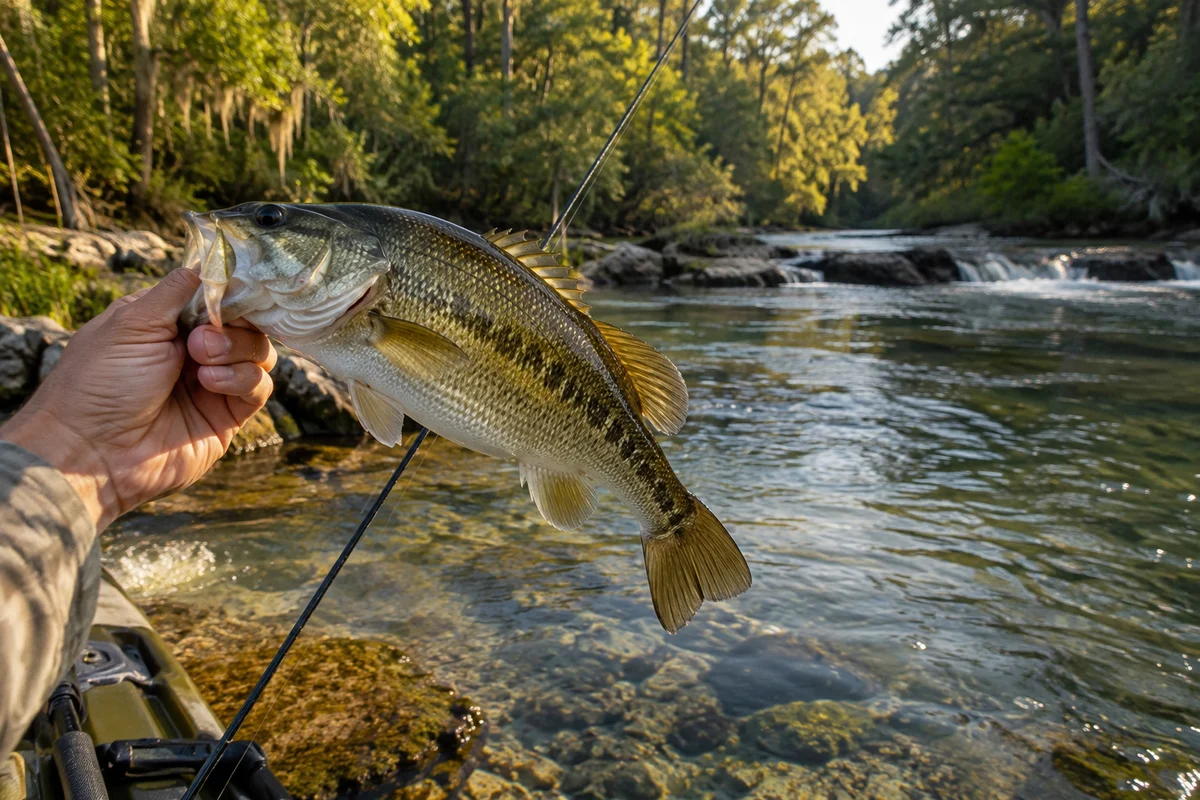
Shoal bass are a distinct black bass species associated with flowing water and rocky habitat in parts of the southeastern United States. That general natural-history context can help explain why a report might name a river or stream rather than a managed lake. It does not, by itself, prove where any record fish was caught. A habitat description is not a substitute for a verified catch location.
If the official listing is unavailable, unclear, or does not identify a specific waterbody, say so plainly. Avoid upgrading a broad region, river basin, or nearby town into a precise catch site. That restraint is especially important when old reports are copied across websites without the original agency record attached.
How do you verify the listed catch location?
Start with the Florida Fish and Wildlife Conservation Commission and navigate to its current freshwater fishing records information. Search for the species name rather than a generic phrase such as “Florida bass record.” Read the complete entry and any accompanying record rules or notes, and make sure the page is an agency source rather than a repost.
Then check what the location field actually represents. It may identify a named waterbody or a broader location, and the public listing may not provide a precise point. Do not infer a launch ramp, shoreline, private property, or exact coordinates from a lake or river name. A record location is useful geographic context, not permission to access land or a guarantee that the same conditions remain.
For an independent comparison, the International Game Fish Association (IGFA) maintains a separate record program at igfa.org. Its records should be treated as a separate system, not as a replacement for Florida’s state listing. Compare species and category definitions before drawing conclusions; the same fish or claim may be handled differently under different rules.
What evidence makes a record claim credible?
A robust record entry should be traceable to the responsible authority and tied to a clearly named species and category. Depending on the program’s rules, documentation can include information about the fish, the catch, the angler, the weighing process, and witnesses or other verification. The precise requirements belong to the organization that recognizes the record, so consult its current rules instead of assuming every program asks for the same paperwork.
For readers evaluating a report, look for a direct link or clear reference to the official listing. Check the publication date and whether the record is described as pending, newly submitted, or officially recognized. Those terms are not synonyms. A reported catch may be awaiting review; a later agency update may confirm it, revise details, or supersede it.
Be wary of exact figures or dates repeated without a primary source. They can be copied from an earlier story, detached from a different species, or presented without the category that made them meaningful. The safest account states only what the official record supports and attributes uncertainty where the public information leaves a gap.
What can anglers learn from a record location?
A verified waterbody can offer broad clues about habitat, not a recipe for repeating a catch. Bass use cover, forage, depth, and seasonal conditions in different ways, and a location’s reputation does not guarantee a fish of record size. Anglers can use the setting as a starting point for learning about local habitat and regulations while avoiding claims that one lure or method caused a particular record unless reliable evidence supports that conclusion.
For practical technique reading, see ODU Magazine’s guides to fishing a 10-inch worm and choosing a lipless crankbait for early-season bass. They discuss general approaches, not a verified recipe for any record catch. Always check current Florida rules for the waters you plan to fish, and respect access limits and private property.
A record location can also draw attention to a fishery. Anglers should avoid publishing sensitive access details that an official record does not disclose, follow local conservation rules, and handle fish responsibly. A notable catch is most useful as a prompt to learn about the species and its habitat—not as a reason to crowd a spot or assume a record is still current.
The reliable answer is the current entry, not the rumor
So, where was the Florida state record bass caught? The accurate answer depends on the species and record category being asked about. For a shoal bass claim, consult the current Florida shoal bass record entry; for largemouth or another species, use that species’ own listing. If an old story or a vague headline does not match a current official entry, it cannot settle the location on its own.
This method gives readers a more durable answer than repeating an unverified place name. It also keeps distinct records from being confused, lets anglers see whether a catch is officially recognized, and makes clear what the public documentation does—and does not—establish. Check the agency listing before citing a location, and preserve its wording when sharing the result.
Frequently asked questions
Where can I check Florida’s current bass records?
Use the Florida Fish and Wildlife Conservation Commission’s current freshwater fishing records information. Search by the exact species, then read the category and location shown in the official entry.
Is a shoal bass record the same as a largemouth bass record?
No. Shoal bass and largemouth bass are distinct species with separate record entries. Verify the species named in the source before repeating a record location.
Does a reported state-record catch mean the record is officially recognized?
Not necessarily. A report may describe a submitted or pending catch. Check the responsible agency’s current listing and record rules to see whether it has been recognized.
Sources & further information
Consult these primary sources for current regulations, technical information and local guidance.