Crankbaits for Crappie: A Practical Guide to Covering Water
Crankbaits can help locate crappie when fish are scattered or holding away from obvious cover. This guide explains how to choose a running depth, make a controlled trolling spread, and know when another presentation is the better choice.
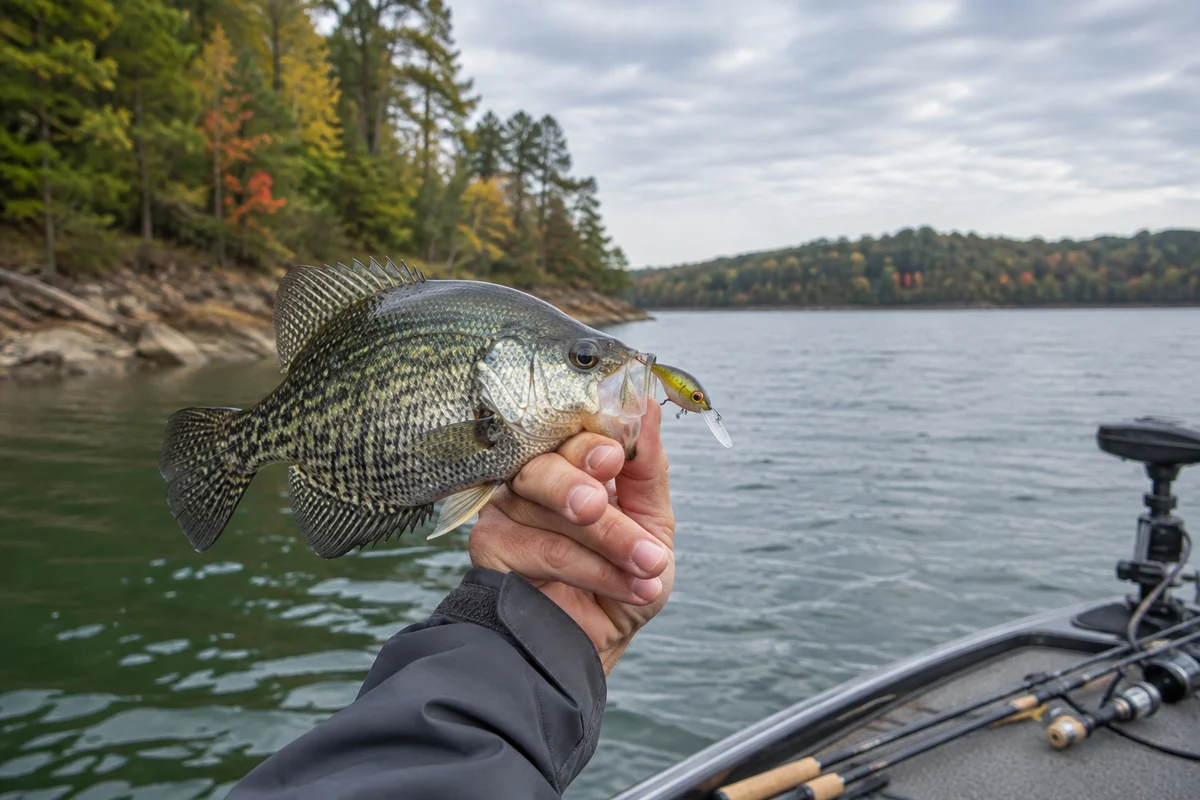
Crankbaits for crappie are most useful when fish are spread across open water or suspended beyond the reach of a short cast. Their value is less about a magic lure and more about covering water at a repeatable depth: when a fish bites, you can revisit the same depth, speed, and area. Trolling small diving plugs is a search method, not a guarantee, and it is especially important to account for local rules, boat traffic, and changing fish location.
When crankbaits make sense
A small crankbait can be a practical choice when crappie are roaming flats, following baitfish, or suspended along a break rather than packed tightly into brush. It lets an angler search a broad zone while keeping the lure moving. The approach can also be useful when a school is found with sonar but individual fish are not responding to a stationary presentation.
Think of the plug as a way to test a hypothesis: perhaps fish are holding over a certain depth, near a submerged edge, or along a windblown bank. A few controlled passes can reveal whether that zone is productive. If bites come at one depth, repeat that pass before changing several variables at once.
Crankbaits are less suitable when fish are buried in dense wood, pinned to a tiny piece of cover, or reluctant to chase. Treble hooks snag readily, and a moving lure can pass above or below fish without attracting them. In those situations, a slower presentation may be more precise. For a different approach to small-profile offerings, see this guide to the Road Runner crappie jig. If cold conditions have slowed fish, compare the presentation with ideas in cold water crappie fishing.
Choose a running depth, not just a lure color
The first selection question is how deep the lure will run under your actual conditions. Manufacturers commonly describe a lure’s intended action or depth range, but real running depth changes with line diameter, line length outside the rod tip, trolling speed, line type, and lure design. Treat package information as a starting point, not a precise reading for every boat and setup.
Begin by identifying the depth where fish appear to be holding, then choose a plug whose expected range can intersect that zone without constantly digging into the bottom. Where sonar is available, use it to distinguish the fish’s depth from the water depth beneath the boat. A school suspended over deep water may be best approached with a lure that runs well above the bottom.
| What you observe | First adjustment | What it tells you |
|---|---|---|
| Fish show at a consistent depth | Try a lure or line setup likely to pass through that band | Tests whether the fish will chase at that level |
| Lure repeatedly contacts bottom | Raise the lure’s path, reduce line exposure, or move to deeper water | Helps avoid snags and excessive disturbance |
| No marks or bites on a pass | Shift the route or depth before cycling through colors | Tests location and presentation efficiently |
| Bites occur along one edge | Repeat the contour or edge at the same pace | Checks whether the pattern is repeatable |
| Fish follow but do not strike | Slow down or switch to a smaller, slower presentation | Suggests movement or profile may be the issue |
Keep adjustments simple. Change one variable—depth, speed, route, or lure profile—then make another pass. This makes the result easier to interpret than changing color, speed, and rod position simultaneously.
Build a controlled trolling pass
Start with a route that is safe and easy to repeat: a broad flat, a gradual break, or the edge of a known travel corridor. Keep clear of swimmers, docks, other boats, and marked hazards. Follow navigation rules and local restrictions, and avoid crossing another angler’s lines. A modest, steady pace helps maintain a consistent lure action; the appropriate speed depends on the plug and conditions, so use the lure’s action and your equipment rather than assuming a universal number.
Let line out in a consistent manner and keep notes mentally or in a simple log: lure, line, approximate amount out, speed setting or boat pace, and depth of the fish. If multiple rods are used, maintain safe spacing and comply with local limits on rods and lines. A spread can cover more water, but too many variables make snags and tangles harder to manage.
When a fish bites, note the exact circumstances. Was the rod closest to the boat or farthest back? Did the bite happen on a turn, over a particular contour, or at the same sonar depth as earlier marks? A turn changes the speed and path of lines across the spread, so a bite there may indicate fish respond to a brief speed change—or simply that the boat crossed a productive patch. Repeat the pass to see whether the clue holds.
Color, profile, and action
Color should be a secondary adjustment after location and depth. In clear water, natural baitfish tones are a sensible starting point; in stained water, stronger contrast can make a moving lure easier to see. Light, cloud cover, water color, and forage all matter, and no color rule works everywhere. Begin with one or two distinct options rather than a large rotation.
Pay attention to size and action as well. A compact plug may better match small forage or suit fish that are hesitant, while a larger profile can be more visible in some situations. But a larger bait is not automatically better for larger crappie, and a particular color does not establish a reliable pattern by itself. If fish trail a lure or bump it without hooking up, try a subtle change in profile or pace, then reassess.
Inspect hooks and split rings regularly. Treble points can bend or dull after contact with rock, wood, or the boat. Replace or sharpen components only in accordance with the product’s design and local regulations, and handle hooked lures carefully. Keep pliers accessible and avoid reaching toward loose trebles near a moving boat.
A simple decision framework
Use this sequence to prevent random changes:
- Locate likely fish. Check seasonal areas and, where legal and available, use sonar to see whether fish are shallow, suspended, or near a break.
- Select a depth band. Choose a lure and line arrangement that can pass through the observed zone without dragging continuously.
- Make a repeatable pass. Hold a steady course and pace; record the route and basic setup.
- Respond to evidence. If fish are present but do not respond, change speed or profile. If fish are absent, move or alter depth first.
- Confirm before committing. Repeat a productive pass. A single bite is useful information, but not proof that every nearby area holds fish.
This framework also helps decide when to stop trolling. If fish are concentrated around a small piece of cover, change to a presentation that can be placed beside or within the opening. Anglers exploring less accessible shorelines may find the discussion of crappie fishing from a kayak useful when planning a quiet, close-range approach. For more seasonal and species-specific context, start at the freshwater panfish fishing hub.
Handling fish and protecting the fishery
Follow the regulations for the specific water you are fishing, including open seasons, length or possession limits, and gear restrictions. Rules can differ between nearby waters and may change; consult the responsible state or provincial agency before a trip. Keep fish intended for release in the water when practical, handle them with wet hands, and minimize the time they spend out of it. Avoid keeping more than you can use and respect any local conservation guidance.
Crankbait trolling can turn an unstructured search into a repeatable process, but conditions remain uncertain. Wind can shift fish, forage can move, and a school can disperse. A productive setup is a clue for that place and moment, not a universal formula. The best outcome is a clear understanding of where the fish were, what depth the lure crossed, and which adjustment is worth testing next.
Frequently asked questions
Are crankbaits effective for crappie?
They can be effective when crappie are scattered or suspended and willing to chase. They are less practical around dense cover or when fish need a slow, precise presentation.
How do I choose crankbait depth for crappie?
Estimate the fish’s depth from conditions or sonar, then select a lure and line setup likely to cross that band. Actual depth varies with speed, line, and amount of line out.
What color crankbait should I start with?
Start with a natural forage-like color in clear water or a higher-contrast option in stained water. Treat color as a test after you have addressed location and running depth.
Can I troll several crankbaits at once?
A spread can cover different depths, but use only the number of rods and lines allowed locally and maintain safe spacing. A simpler spread is easier to control and interpret.
Sources & further information
Consult these primary sources for current regulations, technical information and local guidance.