How to Use Drift Sock to Control Your Boat’s Drift
A drift sock can turn a wind-driven boat into a steadier fishing platform when it is sized, rigged, and deployed thoughtfully. This practical guide covers setup, control, recovery, and the conditions that call for a different approach.
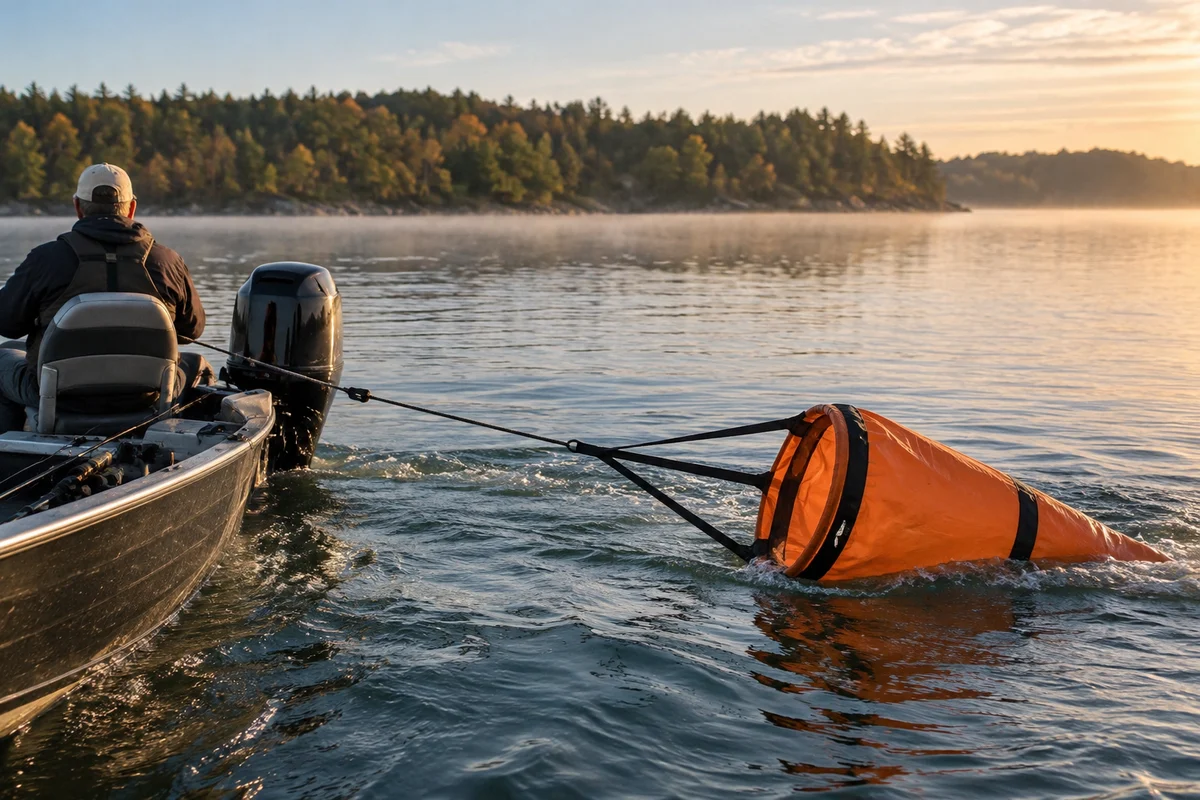
A drift sock is a fabric drag device that helps manage a boat’s movement when wind and current would otherwise push it too quickly across a fishing area. Learning how to use drift sock equipment is less about stopping a boat completely than matching its drift to the water, the wind, and the fishing presentation. A well-managed drift can keep baits in the strike zone longer, improve boat control, and make a broad stretch easier to cover.
The basic method is straightforward: attach the sock to a suitable line and secure point, deploy it clear of people and propulsion, then adjust its position or use a second sock if the boat’s orientation needs correcting. But boats, conditions, and gear vary. Follow the sock manufacturer’s instructions and your boat’s manual, and treat the steps below as general guidance rather than a substitute for either.
What a drift sock does—and what it cannot do
A drift sock, sometimes called a drift anchor, creates water resistance. As the boat moves, the open fabric catches water and slows the boat’s movement relative to the water. It does not anchor the boat to the bottom, hold a fixed position, or guarantee a particular drift speed. Windage, current, hull shape, waves, load, and sock size all affect the result.
That distinction matters. A sock may reduce a fast sideways slide while leaving the boat moving with current. In changing wind or current, the boat can yaw or swing. If you need to remain stationary, or conditions exceed your boat-handling ability, a drift sock is not a replacement for a suitable anchor, safe harbor, or powered maneuvering.
Anglers use drift socks for controlled presentations such as drifting a shoreline, probing a weed edge, or moving across open water. For related freshwater tactics, see our freshwater fishing tips and our guides to choosing a fishing spoon and understanding lake-effect fishing conditions.
Choose a setup for the boat and conditions
Before deploying anything, read the sock’s labeling and instructions. Manufacturers commonly provide sizing guidance by boat length or style, but there is no universal size chart that fits every hull and weather situation. A larger sock generally creates more drag, but also more load on its attachment and line. Never assume that a bigger device is automatically safer or more effective.
| Situation | General setup to consider | What to monitor |
|---|---|---|
| Light drift on open water | One appropriately sized sock from a secure bow or stern point, as the maker directs | Drift direction, boat yaw, line tension |
| Boat swings broadside or tracks poorly | Reposition the attachment point, or consult the sock instructions about a second sock | Waves hitting the hull, load on fittings |
| Narrow shoreline or obstacle nearby | Avoid deploying if there is not room to drift and recover safely | Clearance, wind shift, escape route |
| Strong or changing conditions | Keep the sock stowed and use another safe plan | Forecast, visibility, crew comfort, vessel limits |
A bow deployment and a stern deployment can produce different boat orientation and handling. The right choice depends on hull design, the direction of wind and current, your fishing plan, and the manufacturer’s recommendations. Avoid improvising attachment points: use a strong, intended cleat or other approved point, not a rail, rod holder, or lightweight accessory unless the boat manufacturer explicitly rates it for that load.
Inspect the sock, retrieval line, connectors, and attachment point before each outing. Look for tears, damaged stitching, knots or tangles, corrosion, and wear. A floating marker or retrieval float can help locate the line, but it should be used only as directed and should not create a snag hazard. Keep line lengths and fittings appropriate to the boat and water; excess loose line can foul a propeller or entangle a person.
How to deploy a drift sock
- Check conditions and plan an exit. Note wind direction, current, waves, nearby traffic, shorelines, shallow areas, and hazards. Make sure there is room to drift and retrieve the device. If the weather is deteriorating or the boat is already difficult to control, do not deploy it.
- Brief everyone aboard. Tell passengers where the line will run and where to stay clear. Keep hands, feet, clothing, and fishing tackle away from the line and its connection points. A loaded line can move suddenly.
- Prepare the line while the boat is controlled. Follow the product’s instructions for connecting the sock, bridle, and retrieval line. Keep the line clear of the motor, propeller, steering gear, and other equipment. Do not wrap a line around a hand or body.
- Attach to a suitable point. Secure the assembly to a strong, designated fitting recommended by the boat maker and sock maker. Check the connection before putting the sock in the water. Do not tie off to a person or hold a loaded line by hand.
- Lower the sock deliberately. Put it over the side only when it is clear of the propeller and people. Let it open and load gradually; avoid throwing a tangled line or dropping the whole assembly into the water. Keep control of the retrieval line without placing yourself in a position where it can snag or pull you overboard.
- Observe before making adjustments. Watch how the boat responds for a short period. If drift is still too fast, first confirm that the sock is open, the line is clear, and the setup matches the maker’s instructions. Do not add improvised weight or overload the attachment point.
- Retrieve before maneuvering or entering hazards. Follow the manufacturer’s recovery method. Bring the sock aboard in a controlled way, keep the line away from the propeller, and stow it so it cannot trip or snag anyone. Retrieve it before using the motor to reposition unless the product and boat instructions specifically allow otherwise.
Fine-tune drift without overloading the boat
Once the sock is working, judge the drift by what the boat is doing, not by an assumed speed. GPS speed over ground can be useful, but it reflects current as well as movement through the water. A fish finder’s display and the angle of a line or bait can also help reveal whether the presentation is moving too quickly, but neither is a substitute for watching wind, waves, and boat behavior. For more on interpreting electronics, explore our overview of fish-finder comparisons and what to evaluate.
If the boat turns repeatedly, the sock may be attached at a point that lets the hull swing, or conditions may be shifting. Consider changing the deployment point only after retrieving the sock and confirming the alternative is permitted by the boat and sock makers. A second sock can help some boats track more steadily, but it adds drag and load; use one only when the instructions support that configuration and the fittings are suitable.
If the sock seems ineffective, check for a closed or twisted canopy, an unsuitable size, a line that is too short or tangled, or a wind/current combination that overwhelms the setup. A sock is not a tool for forcing a boat into a particular heading against powerful conditions. When control is uncertain, recover it and move to a safer plan.
Safety, limits, and common mistakes
Never deploy a drift sock near swimmers, nets, submerged hazards, or other boats where the line could create danger. Avoid fishing around the line, and keep it clear of anchors and downriggers. Do not leave a deployed sock unattended or assume that its presence makes rough water safe. Monitor weather and maintain a life jacket for each person aboard; wear one when conditions and local rules require it. Follow navigation rules and any applicable state boating regulations.
Common errors include attaching to an unapproved fitting, letting line reach the propeller, deploying too close to shore, and trying to retrieve under tension with hands wrapped in line. Another mistake is expecting a sock to stop drift entirely. If your boat’s drift remains too fast for safe fishing, change locations or conditions rather than continually increasing drag beyond the equipment’s intended use.
Quick pre-deployment checklist
- Sock and line are intact and correctly assembled.
- Attachment point is suitable and approved for the load.
- Propeller, steering, and passenger areas are clear of line.
- Everyone aboard knows where the line will run.
- There is adequate room to drift, turn, and retrieve.
- Weather, waves, visibility, and boat handling remain within safe limits.
- Retrieval is planned before approaching obstacles or using the motor.
When to retrieve the sock
Retrieve the sock if wind or waves increase, the boat starts yawing unpredictably, the line chafes or snags, traffic approaches, or you need to maneuver. Do not wait until you are beside a hazard to bring it aboard. If it cannot be recovered safely, prioritize people and vessel safety, avoid putting anyone in the water, and seek appropriate assistance according to local procedures.
The best drift-sock setup is the one that slows your boat without compromising control. Start with the manufacturer’s sizing and rigging guidance, deploy only in conditions that leave room for recovery, and make small, observable adjustments. With those limits in mind, a sock can make a wind-driven drift more deliberate while leaving the angler—not the equipment—in charge of the decision to continue.
Sources and further guidance
- U.S. Coast Guard Boating Safety
- U.S. Coast Guard Navigation Rules and Regulations
- BoatUS Foundation: Boating Safety
Frequently asked questions
Does a drift sock stop a boat completely?
No. It adds water resistance and can slow a drift, but wind, current, hull shape, and conditions still move the boat.
Should a drift sock go off the bow or stern?
It depends on the boat, conditions, fishing plan, and manufacturer guidance. Choose an approved attachment point and monitor how the boat handles.
Can I use two drift socks at once?
Only if the sock and boat instructions support that configuration and the attachment points can handle the added load.
When should I retrieve a drift sock?
Retrieve it before maneuvering, approaching hazards, or when conditions worsen, the boat becomes difficult to control, or the line snags.
Sources & further information
Consult these primary sources for current regulations, technical information and local guidance.