How to Drive Boat in Big Water: A Safer Approach
Big water calls for conservative decisions before and during the run. Use weather, boat limits, route options, and crew readiness to decide whether to go, slow down, or turn back.
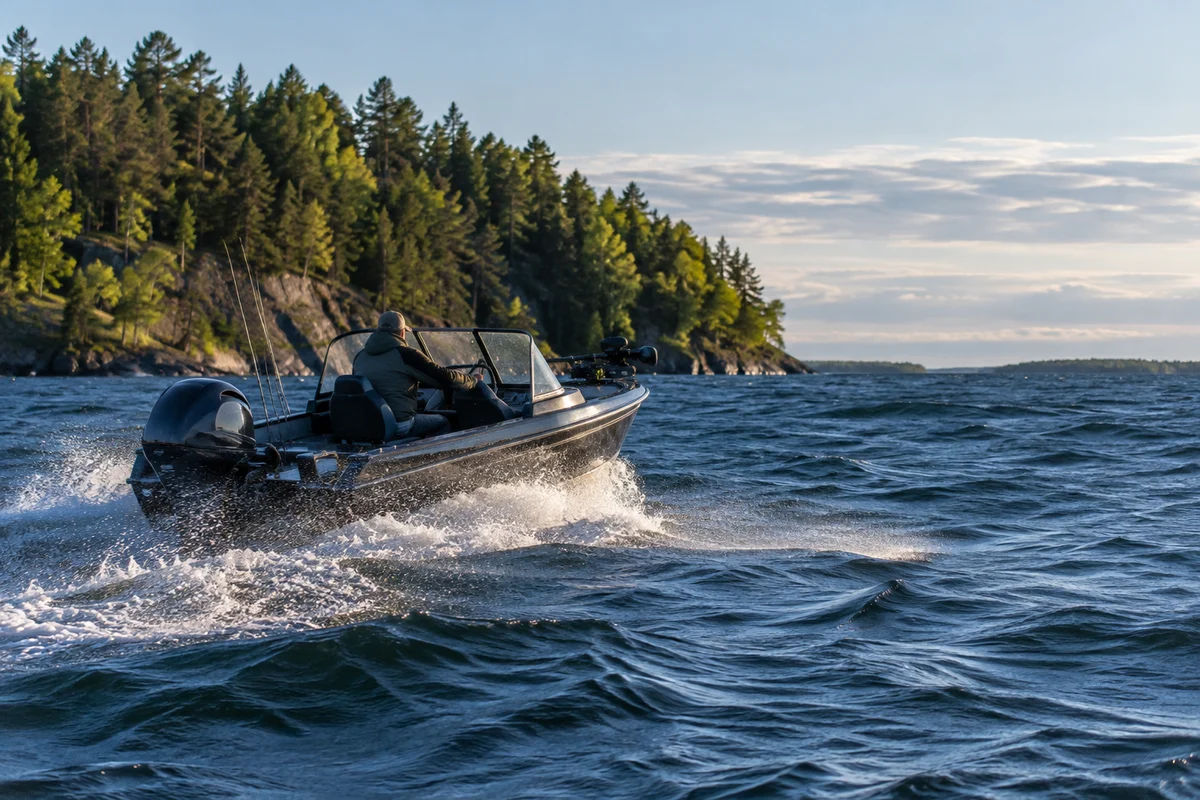
Learning how to drive boat in big water starts before the engine turns over: check the forecast, understand your boat’s limits, and decide what conditions will make you cancel or head back. “Big water” can mean a large lake, reservoir, bay, or exposed stretch where waves have room to build. There is no single speed or maneuver that makes every boat safe in every wave. If conditions exceed your experience or equipment, staying ashore is the right seamanship—not a failure.
What counts as big water for your boat?
Wave height alone does not describe the challenge. Wind direction and duration, wave spacing, currents, boat length and hull design, load, visibility, and nearby shelter all matter. Short, steep waves can be uncomfortable and difficult to handle even when they look modest. A long, rolling swell may be manageable for one well-prepared boat but demanding for a smaller craft or inexperienced crew.
Read the marine forecast for the specific water you plan to cross, and check it again near departure. Look for wind speed and direction, gusts, wave conditions, thunderstorms, fog, and advisories. A forecast is not a guarantee: local shorelines and terrain can change conditions, and weather can deteriorate. The U.S. Coast Guard’s boating safety resources offer general safety guidance; local authorities and the relevant marine forecast provide the conditions for your route.
Set a personal limit before you launch. Consider the least experienced person aboard, the boat’s capacity plate and owner’s manual, the distance to safe shelter, and whether you can return against the expected wind. Do not treat a capacity rating as a promise that the boat is suitable for every wave condition.
How should you prepare before leaving the dock?
Inspect the boat, motor, steering, fuel, drain plugs, and required safety equipment according to the owner’s manual and local rules. Secure loose gear low and distribute people and equipment so the boat remains balanced. Everyone should wear a properly fitted life jacket appropriate to the activity; keep it on, rather than stowed, when conditions are unsettled. Carry a reliable way to call for help, and make sure someone ashore knows your plan and expected return time.
Brief the crew. Explain where to sit, how to move only when instructed, where safety equipment is, and what to do if someone falls overboard. Keep passengers seated while underway and discourage sudden movement. Children and anyone unfamiliar with the boat need clear, simple instructions. If visibility is poor or the crew is cold, tired, or anxious, the safe margin shrinks.
Plan a route that favors protected water and known shelter rather than the shortest line. Identify launch points, harbors, lee shores, and places where you can wait safely. Avoid assuming that a shoreline is safe refuge: wind can push a boat toward rocks, shoals, or other hazards. Leave enough fuel for delays and a return route, with a reserve consistent with your boat’s guidance and conditions.
How do you choose a route and speed?
In waves, focus on maintaining control, not making time. Reduce speed early enough to avoid pounding, loss of control, or launching the bow into a wave. There is no universal speed setting: hull shape, wave period, loading, and direction all change the response. Follow the boat manufacturer’s operating guidance and use training to build judgment. If the boat is slamming, taking spray over the bow, or becoming difficult to steer, slow further, alter course toward safer water when possible, or turn back.
Choose a heading that lets the boat meet waves in a controlled way, adjusting gradually as conditions require. A direct, rigid rule such as always taking waves from one exact angle can be unsafe; the best course depends on the boat and sea state. Avoid abrupt turns, especially at speed, and do not cross another vessel’s wake without assessing its shape and your own stability. Keep a lookout for traffic, floating debris, markers, and changing water conditions.
Give yourself room. Do not crowd another boat, run close to shore in unfamiliar water, or commit to a narrow passage if waves and current leave little margin. If the route requires a maneuver you have not practiced, choose a safer route or postpone the trip.
What should you do as waves build?
Keep the crew informed and reassess often. Watch the horizon, wind, cloud buildup, visibility, and the behavior of the boat. Waves may build after the forecast is issued, and a comfortable outward trip can become difficult on the return when wind or current shifts. Decide early to shorten the trip or seek shelter; waiting until the boat is overwhelmed removes options.
If conditions become uncomfortable, reduce speed and steer toward the safest available shelter without making sudden movements. Keep passengers seated and distribute weight as directed by the boat’s manual. If the boat is taking on water, use the bilge system as designed and call for assistance early. Do not ask an untrained passenger to perform risky tasks or move around a pitching boat.
A person overboard is an emergency. Keep the person in sight, alert everyone, use the boat’s established recovery procedure, and call for help when needed. Do not make a fast, uncontrolled turn that puts others at risk. Practice emergency procedures in calm conditions with qualified instruction, rather than improvising them in rough water.
When is turning back the safest choice?
Turn back or stay ashore when the forecast is beyond your limits, visibility is closing in, waves are steepening, the boat is being repeatedly struck or swamped, or anyone aboard is uncomfortable. Also reconsider if the motor or steering behaves unpredictably, safety equipment is missing, or you cannot identify a safe route to shelter. A schedule, destination, or good fishing report is never worth overriding those warnings.
For cold water, treat immersion as a serious risk even if the air feels mild. Wear suitable clothing and a life jacket, and do not assume you can simply swim to shore. If you are uncertain about the boat, route, or conditions, seek instruction from a qualified boating educator before attempting exposed water. The safest decision may be to wait for a better day.
These habits fit into a broader approach to time on the water: prepare, observe, and leave room to change plans. Browse more outdoor coverage for practical fishing and boating topics, including fishing questions and elbow pain relief for anglers—useful reminders that a good day outside begins with thoughtful choices.
What mistakes make big-water boating riskier?
A common mistake is treating a familiar lake as predictable. Wind can change quickly, and a route that felt easy in one direction can become difficult on the way home. Another is loading the boat without checking capacity guidance or securing equipment. Loose tackle, coolers, and batteries can shift, affecting balance and creating hazards.
Avoid relying on a phone alone for navigation or emergency contact; battery life and coverage can fail. Do not follow another boat’s speed or course without understanding its size, handling, and destination. And do not keep going simply because you have already traveled far. Turning around while you still have options is better than waiting until shelter is hard to reach.
A conservative checklist for the launch
Before departure, confirm the forecast and your personal limits; inspect the boat and required equipment; make sure life jackets fit and are worn; secure and balance the load; tell someone your plan; identify shelter and a return route; and brief every passenger. While underway, maintain a lookout, keep speed appropriate to the conditions, and reassess continuously. If the water exceeds your ability or the boat’s safe operating range, do not launch—or head back early.
FAQ
Is there a universal safe speed for driving a boat in big water?
No. Safe speed depends on the boat, wave shape and spacing, load, visibility, and operator skill. Follow the owner’s manual, maintain control, and slow or turn back if the boat pounds or becomes difficult to steer.
Should I head straight into waves?
Not as a universal rule. A controlled heading depends on the wave pattern, current, boat design, and available route. Avoid abrupt turns and seek qualified instruction for your boat and local conditions.
What should I do if conditions worsen after launch?
Reassess early, reduce speed, keep passengers seated, and choose the safest available route to shelter or back to shore. Call for assistance before the situation becomes an emergency; never press on just to keep a schedule.
Frequently asked questions
Is there a universal safe speed for driving a boat in big water?
No. Safe speed depends on the boat, wave shape and spacing, load, visibility, and operator skill. Follow the owner’s manual, maintain control, and slow or turn back if the boat pounds or becomes difficult to steer.
Should I head straight into waves?
Not as a universal rule. A controlled heading depends on the wave pattern, current, boat design, and available route. Avoid abrupt turns and seek qualified instruction for your boat and local conditions.
What should I do if conditions worsen after launch?
Reassess early, reduce speed, keep passengers seated, and choose the safest available route to shelter or back to shore. Call for assistance before the situation becomes an emergency; never press on just to keep a schedule.
Sources & further information
Consult these primary sources for current regulations, technical information and local guidance.