Lake Effect Fishing: Find Better Windows on Windy Lakes
Lake effect fishing is less a special technique than a way of reading how wind-driven weather reshapes a lake. Use this practical framework to identify productive water while keeping forecasts, cold exposure and changing conditions in view.

Lake effect fishing can change a familiar lake in a few hours. A shift in wind may build waves on one shore, push floating food toward another, muddy a shallow bay or make a previously sheltered route unsafe. The useful question is not simply whether the weather is good or bad; it is what the current conditions are doing to the water you can reach safely.
“Lake effect” has two related meanings for anglers. Local wind and weather alter conditions directly on a lake, while the broader Great Lakes region can experience lake-effect clouds, rain or snow as air moves across comparatively warmer water. Either way, the effects are highly local and change with season, wind direction, shoreline shape and the lake’s temperature. No single forecast or rule guarantees fish will feed. A deliberate routine—check the forecast, map exposure, observe the water, then adjust—makes lake effect fishing more understandable and safer.
What lake effect means for a fishing day
Wind transfers energy to the water. Its direction and duration help determine which shore receives the strongest waves and where surface water, plankton and drifting material may collect. The result depends on the lake’s size and shape: a long stretch of open water gives wind more room to build waves than a small, protected cove. Islands, points and steep banks can create pockets of shelter beside exposed areas.
On the Great Lakes, cold-season weather can become especially changeable when cold air passes over relatively warmer water. Bands of cloud, snow or rain may affect one area more than another. Local conditions can differ from a forecast for a nearby town, and a calm harbor does not prove that open water is safe. Inland lakes also respond to wind and passing weather, though they do not necessarily experience the same regional snow patterns.
For anglers, these changes matter because they affect access, visibility, comfort and fish location. Wind can make casting difficult or turn a small boat ride hazardous. Rain and wave action may reduce clarity near shore. A windward bank can concentrate drifting food, but heavy chop or rapidly cooling water may make that bank a poor choice—or an unsafe one. Treat fish behavior as a possibility to investigate, not a promise.
Start with safety, not a fishing spot
Before leaving, check current and forecast conditions from reliable local weather and marine sources. Look at wind speed and direction, gusts, precipitation, air temperature, advisories and the timing of expected changes. On a large lake, consult the appropriate marine forecast rather than relying only on a general land forecast. Recheck conditions during the outing; lake weather can move faster than a plan.
Decide in advance what would make you turn back or stay ashore. For a boat, that decision should reflect the vessel, operator experience, route, visibility, water temperature and the weakest member of the crew—not an abstract threshold copied from another angler. Wear a properly fitted life jacket, carry required safety equipment, tell someone your plan and avoid crossing exposed water when conditions exceed your ability. Cold water can incapacitate quickly, even when the air feels mild. On shore, keep a safe distance from breaking waves, slippery rocks, ice edges and unstable banks.
| Conditions you observe | What they may mean | Practical response |
|---|---|---|
| Wind builds across a long open fetch | Waves and drift may increase; exposed banks may become difficult | Favor protected access, shorten the route, or postpone the trip |
| Water turns cloudy near a windward shore | Waves may be stirring sediment or moving debris | Compare nearby clearer water; use only an approach suited to visibility and conditions |
| A sheltered bay stays calm while the main lake roughens | Local exposure differs sharply | Fish the sheltered area if access and rules permit; do not assume the return route will stay calm |
| Rain, snow or visibility worsens | Navigation, footing and temperature risks rise | Reassess immediately, retreat early, and stop if safe travel is uncertain |
| Conditions remain stable and manageable | You can compare locations more deliberately | Make one change at a time and note what the water is doing |
This is a decision aid, not a substitute for official warnings or sound judgment. If there is doubt about safe access, choose another day or a protected location.
Read wind, shoreline and water clarity together
Begin with a map. Identify the direction the wind is coming from, the length of open water it crosses, and the points, islands and coves that break it up. A shore facing into the wind is often called windward; the opposite side is leeward. Those labels describe exposure, not guaranteed fishing quality. A windward shoreline may receive more wave action and drifting material, while a leeward bank may remain clearer and easier to fish. The best option depends on species, season, depth, local habitat and how much disturbance the water can tolerate.
At the access point, pause and observe before choosing tackle or committing to a crossing. Note wave direction, the rhythm of sets, floating debris, surface foam, water color and whether conditions are changing. Compare water at the edge with a sheltered pocket nearby. If a bank is becoming too turbid to see hazards or waves are striking with force, do not move closer just because it looks active.
Make a small, controlled comparison. Try a safe, accessible edge with some wind influence, then a nearby protected area. Keep depth, presentation and time similar where practical. If you change location, bait and method together, you will not know which factor mattered. Record simple observations: wind direction, clarity, temperature trend if known, location type and what happened. A few notes across seasons are more useful than assuming one windy-day pattern applies everywhere.
Adapt your approach without overcomplicating it
When wind makes line control difficult, shorten casts, choose a more protected angle or fish a bank where you can maintain contact with your presentation. Use tackle appropriate to the species and local regulations; do not compensate for unsafe conditions by pushing farther into exposed water. In clear, calm pockets, a subtler approach may be easier to control, while a wind-stirred edge may call for a presentation that remains detectable in reduced visibility. These are starting points, not universal rules.
For boat anglers, plan the route around exposure rather than the shortest distance. Keep a safe exit available, avoid crossing open water to chase a speculative bite and account for the conditions on the return trip. A protected shoreline can offer useful water without requiring a hazardous crossing. For shore anglers, assess footing and retreat paths before casting. Rising water, wet rock and wave surges can make a familiar ledge dangerous.
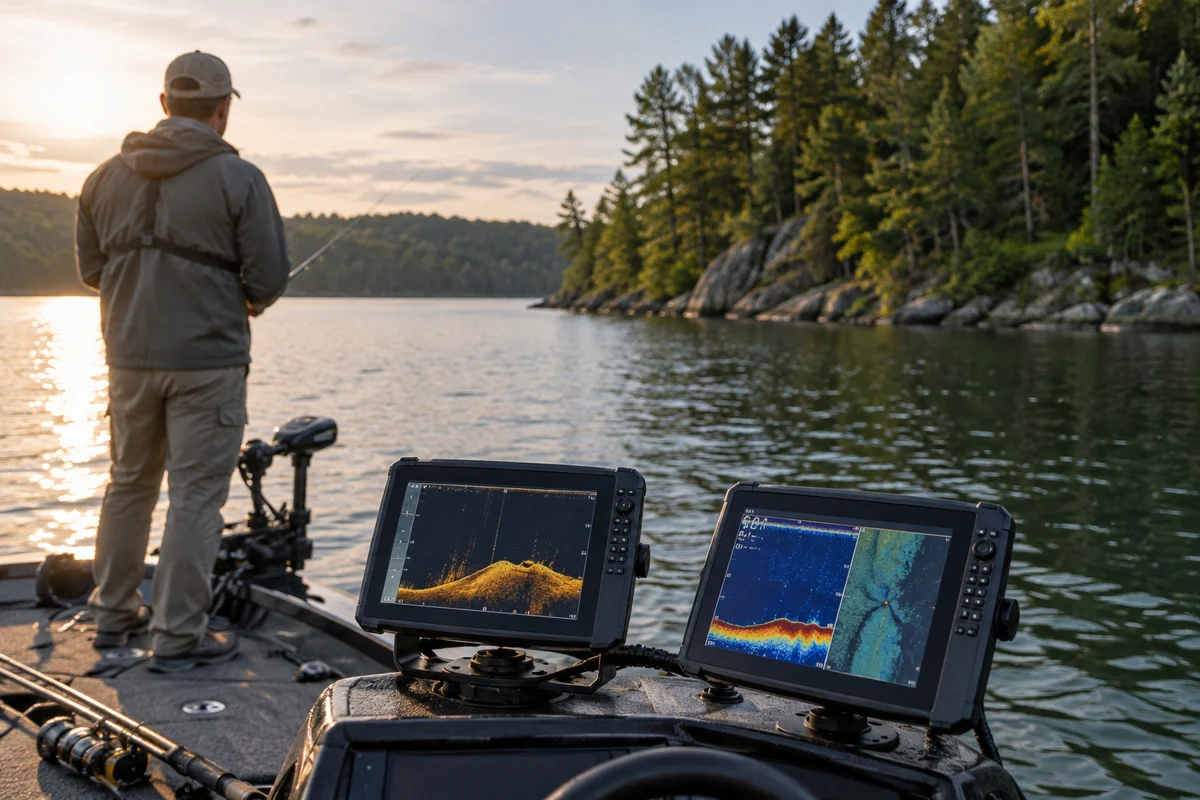
If electronics are part of your routine, use them as one information source rather than a guarantee. Compare readings with the map, surface conditions and known limits of your equipment. Our overview of Lowrance vs. Garmin fishfinders discusses how to think about fish-finder information without treating a display as a substitute for observation. For broader ideas about selecting a destination to match your trip, see our guide to best fishing destinations.
Seasonal clues—and their limits
In warmer months, wind can mix surface water and move floating material, but the temperature response varies by depth, lake size and weather history. In spring and fall, changing temperatures and seasonal fish movements may overlap with wind effects, making it difficult to credit a bite to one cause. In cold weather, lake-driven precipitation and rapidly changing visibility may be more important to the outing than any potential fishing advantage.
Species also differ. Some fish use shallow edges or current-influenced areas under particular conditions; others may remain deeper or shift with forage and temperature. Local regulations, seasonal closures and habitat protections determine where and how you may fish. Check current rules and local fisheries guidance before planning around a species-specific pattern. The freshwater fishing tips hub is a useful starting point for related planning and technique articles.
A simple lake-effect decision framework
Use this sequence when conditions are unsettled:
- Check the official forecast and advisories. Include marine conditions where relevant, plus wind shifts, precipitation and visibility.
- Choose a safe exposure level. Pick a shore, access point or route you can reach and leave without relying on conditions improving.
- Observe before committing. Look at wave action, clarity, debris and the rate of change from a safe position.
- Compare nearby water. If safe, test a protected and a more exposed location while changing as few variables as possible.
- Set a stop rule. Leave when conditions worsen, visibility or footing becomes unsafe, or the trip no longer fits your group’s ability.
- Keep notes. Record observations, not assumptions: “windward bank, stained water, gusts increasing” is more useful than “wind always helps.”
The central lesson is that lake effect fishing rewards attention, not bravado. Wind and weather can make some water more interesting while making other water inaccessible. Read the forecast, understand the shoreline, compare conditions carefully and be willing to stop. The safest location is the one you can fish—and leave—under the conditions actually present.
Frequently asked questions
What does lake effect mean for fishing?
It describes local changes caused by wind and weather on a lake, and, in Great Lakes regions, weather such as snow or rain formed as air moves over the water. Effects vary by shoreline, season and conditions.
Is a windy shore always better for fishing?
No. Wind may move floating material or alter clarity, but it can also create unsafe waves and difficult conditions. Compare exposed and sheltered water only when access is safe.
How should I plan a Great Lakes fishing trip during lake-effect weather?
Check current marine forecasts and advisories, plan around exposure and visibility, wear a life jacket when boating, and be ready to cancel or retreat as conditions change.
Does lake effect fishing apply to small inland lakes?
Wind and passing weather affect inland lakes too, but regional lake-effect snow patterns are especially associated with the Great Lakes. The scale and local response differ by lake.
Sources & further information
Consult these primary sources for current regulations, technical information and local guidance.