Weedless Fishing Lures: How to Choose and Fish Them
Weedless designs make it easier to fish around vegetation, timber and other snag-prone cover, but they are not snag-proof. This guide explains how to choose a style, rig it thoughtfully and adjust your retrieve to the conditions.
Fishing around grass, brush and wood often means accepting a tradeoff: the cover may hold fish, but it can also catch hooks. Weedless fishing lures are built to reduce that problem by shielding or guarding the hook until a fish takes the bait. They are useful tools, not snag-proof ones—and the right choice depends on the cover, the lure’s action and how you plan to fish it.
This guide covers common weedless designs, how to choose among them, and practical ways to fish them without confusing “weedless” with “risk-free.” Local rules and the needs of the species you pursue still matter. For more freshwater fundamentals, visit the freshwater fishing tips hub.
What makes a fishing lure weedless?
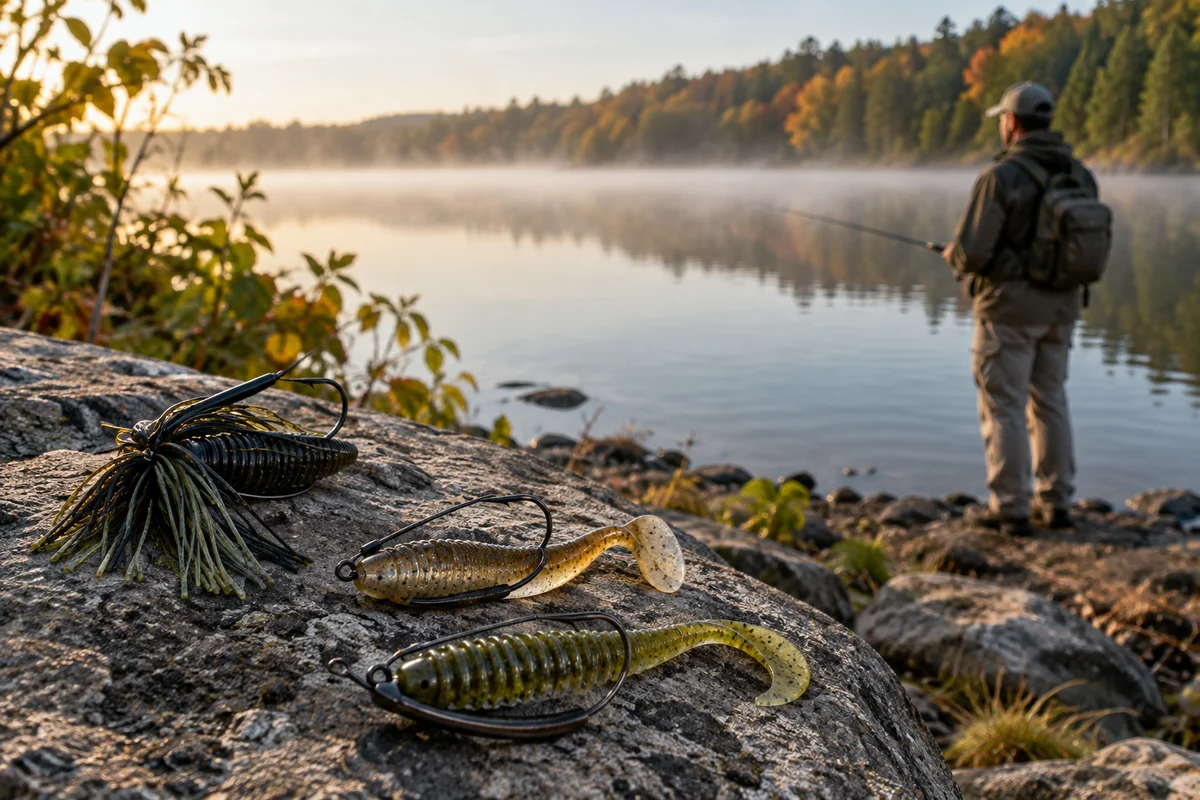
A weedless lure has a feature intended to keep its hook from catching cover as readily as an exposed hook would. That feature might be a wire guard, a hook point tucked into a soft-plastic bait, or a design that positions the hook close to the body. Some lures use a single hook rather than exposed trebles. Each approach changes both snag resistance and how readily the hook can catch a fish.
The protection is a compromise. A guard stiff enough to deflect stems may also make it harder for a hook to reach the fish. A hook buried too deeply in a soft bait may resist snags but require a firmer, well-timed hookset. Conversely, a point barely covered by plastic may catch more readily—but also pick up vegetation more often.
Think of “weedless” as a reduction in snag risk, not a guarantee. Open hooks can still catch fish effectively in open water, while protected hooks can still snag in roots, branches, thick grass or tangled debris.
Common weedless lure styles
Soft plastics with a protected hook
Many soft-plastic baits are rigged with the hook point just under, or lightly through, the surface of the bait. A common approach is to align the bait straight on the hook and keep the point close to the body without burying it far into the plastic. This helps the bait slide past stems and leaves while leaving the point better positioned to emerge when a fish bites.
Rigging details vary with hook shape, bait thickness and local regulations. Check that the bait is straight rather than twisted; a crooked bait can spin, track poorly or collect weeds. If the point is fully buried, make sure the bait can compress enough for the hook to emerge. If the point is exposed, expect less protection.
Wire-guarded hooks
A wire guard sits in front of the hook point and deflects some vegetation or branches. These are often paired with compact soft baits or skirted lures. Guards differ in stiffness and arrangement; a guard that is too stiff for the bait or fish may impede hook penetration, while one that is too soft may fold into cover.
Single-hook and skirted designs
Some lures use a single hook positioned near the body, sometimes with a guard or skirt. The profile can move through certain cover more cleanly than a lure with multiple exposed trebles. These designs can be practical where weeds or wood make exposed hooks troublesome, though the lure may have a different action from a comparable treble-hook model.
Weedless spoons and specialty designs
A spoon or other hard bait may use a single hook, a guard, or a hook positioned against the body. These can be useful in vegetation where an exposed treble would foul quickly. They do not all behave alike: a guard, hook orientation and lure shape influence how the bait falls and moves. Check the manufacturer’s guidance for the particular design rather than assuming every protected spoon can be fished the same way. For a broader look at spoon styles and uses, see our guide to the best fishing spoon.
How to choose for the cover
Start by identifying what is actually causing snags. Soft vegetation, brush, woody branches, rock and floating debris call for different compromises. A bait that slides through broad leaves may still wedge between branches; a guard that deflects grass may not prevent a line from wrapping around submerged wood.
| Cover or condition | Useful starting point | What to watch for |
|---|---|---|
| Sparse grass or scattered weeds | Soft plastic with the point lightly protected | Too much exposed hook may collect stems; deeply buried points can reduce hookups |
| Dense vegetation | Compact profile and a protected single hook | Thick cover may require suitable tackle and careful fish handling; check local access and vegetation rules |
| Brush or laydowns | Guarded hook or compact single-hook lure | Branch forks and roots can snag line or lure bodies even when the hook is protected |
| Open pockets within weeds | More exposed hook or a less-protected rig | Better hook access can increase snags along the pocket edge |
| Mixed cover and open water | A versatile rig that can be adjusted quickly | Recheck hook exposure and bait alignment as the conditions change |
These are starting points, not fixed prescriptions. Species, bait size, water clarity, current, season and fishing regulations all affect what makes sense. If a lure repeatedly comes back fouled, change its path or protection rather than simply casting harder into the same tangle.
A practical setup and retrieve checklist
Before casting, work through this short check:
- Match the hook to the bait. The hook should suit the bait’s thickness and length. A mismatch can make the lure sit crooked or leave too little room for the point to emerge.
- Align the bait. Keep a soft bait straight on the hook. Confirm that the point is protected only as much as needed for the cover.
- Test the action. In clear, shallow water, watch the lure move beside the bank or boat. If it rolls, spins or tracks oddly, correct the rig before covering water.
- Choose a route through cover. Cast to edges, openings and lanes first. Let the lure travel along a clean path rather than forcing it through every dense obstruction.
- Use a controlled retrieve. A steady swim, lift-and-fall or short pause may work, depending on lure type and target species. Watch for the lure fouling and adjust promptly.
- Inspect after contact. Remove clinging plants, check that the bait has not slid down the hook, and inspect the line for abrasion after brushing wood or rock.
A weedless lure is often most effective when it is presented deliberately. Make accurate casts to likely lanes and openings, then vary speed and pauses enough to learn how the bait moves. If you are exploring a new pond or lake, our overview of best fishing destinations offers broader ideas for planning freshwater trips; always verify access and current local rules before heading out.
Hooksets, snags and fish care
There is no single hookset rule for every protected-hook lure. With some soft plastics, anglers leave enough slack-free line to respond to a bite and use a firm, controlled hookset so the bait compresses and the hook can reach the fish. Other lure and hook combinations may call for a different motion. Follow the lure maker’s recommendations when available, and practice with the specific rig in open water before using it in heavy cover.
If the lure hangs up, avoid yanking repeatedly or pulling the rod to its limit. Change the angle, move closer when safe, or use a purpose-made lure retriever according to its instructions. Be mindful of hooks under tension, and do not wade into unsafe water or climb unstable banks to retrieve tackle. A lost lure is preferable to an injury.
When a fish is hooked near cover, use tackle appropriate to the species and conditions, keep control of the fish where possible, and handle it in line with local fish-care guidance. Wet hands before handling, minimize time out of water, and release fish carefully when required or intended. Barbless hooks or suitable hook-removal tools may help with release, subject to local regulations and the lure’s design.
Common mistakes to avoid
- Assuming weedless means snag-proof. Lure bodies, line and guards can still catch on branches, roots and debris.
- Hiding the point too deeply. Extra protection can come at the cost of hook access. Test the rig and adjust incrementally.
- Fishing a bent or twisted bait. Poor alignment can spoil action and make the lure collect vegetation.
- Using one setup for every kind of cover. Grass, wood and rock behave differently; change lure or route as needed.
- Ignoring line condition. Cover can abrade line. Check it regularly and replace damaged sections.
- Overworking the lure. A frantic retrieve may pull it into stems or branches. Begin with a controlled presentation and observe what happens.
Choosing with confidence
The best weedless setup is the one that balances snag resistance with dependable action and hook access in the cover you actually face. Start with a protected hook for the most troublesome areas, test the rig in open water, and make small adjustments to point exposure, bait alignment and retrieve. Keep the limits in mind: no design avoids every snag, and no setup replaces safe handling or knowledge of local rules.
If you regularly switch between open water and cover, a well-organized kit makes adjustments simpler. Our guide to the best tackle backpack discusses carrying tackle so you can keep a few lure styles and basic tools accessible without bringing everything on every trip.
Frequently asked questions
Are weedless fishing lures completely snag-proof?
No. They reduce the chance of the hook catching cover, but the lure, line or hook can still snag on vegetation, wood, rocks or debris.
How should I rig a soft plastic to make it weedless?
Align the bait straight and place the hook point just under or lightly through its surface, adjusting for the hook and bait design. Test the action and make sure the bait can compress enough for the point to emerge.
Do weedless lures work in wood as well as weeds?
Some do, but protection that helps deflect vegetation may not prevent a lure or line from catching in branches and roots. Choose a compact design and fish deliberate lanes through woody cover.
Should I use an exposed or protected hook?
A protected hook can reduce snags in cover, while an exposed point may provide easier hook access in open water. Match the choice to the cover, lure and applicable fishing regulations.
Sources & further information
Consult these primary sources for current regulations, technical information and local guidance.