Frog Fishing for Bass: A Practical Guide to Topwater Success
A practical guide to choosing water, tuning your retrieve, and handling missed strikes when fishing hollow-body frogs for bass. Match your approach to cover and conditions rather than relying on one cadence.
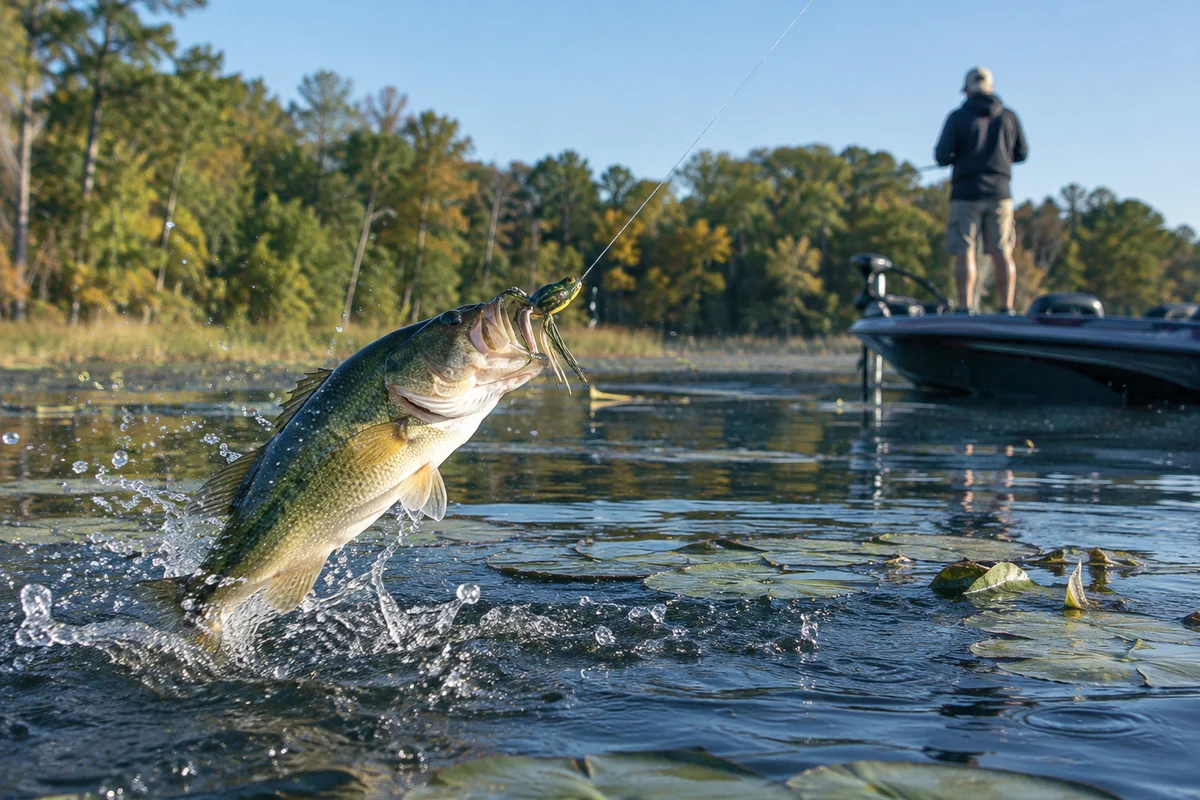
Frog fishing for bass is most useful when vegetation, branches, or shallow cover make other lures difficult to work. A hollow-body frog can travel across that surface without dragging a treble hook through every stem, and its pauses and direction changes can imitate vulnerable prey. Success, however, depends less on a magic retrieve than on choosing the right lane, keeping contact with the lure, and responding calmly when a fish strikes.
Frogs are not limited to summer or to a single type of pond. They can draw strikes around shallow cover whenever bass are willing to feed near the surface. Start with the conditions you can observe: water clarity, wind, cover density, and whether fish are showing themselves. For a broader foundation on seasonal location and tackle, see our bass fishing for beginners. For more freshwater guidance, visit the freshwater bass fishing hub.
Where should you fish a frog?
Look for edges and openings that let a bass approach while giving the lure room to move. Lily-pad borders, grass points, pockets in floating vegetation, overhanging branches, and shaded shoreline cover are useful places to begin. The most productive-looking spot is not always the thickest mat: dense cover can conceal fish, but a frog needs a clear enough path for you to work it and for a fish to take it.
Make casts that cover a likely route rather than repeatedly landing in the same pocket. Work parallel to a weed edge to keep the lure in the strike zone longer. Then cast across points, isolated clumps, and gaps. A frog landing softly near cover is often preferable to crashing into the center of a small opening. If wind pushes floating vegetation or creates a surface ripple, use it to approach from a position where you can keep the lure moving naturally without losing sight of it.
Cover is not proof that bass are present. If several careful presentations produce no sign of life, change the angle, move to a different patch, or try a lure that runs below the surface. A floating buzz bait is another surface option for open lanes, while a swimming jig can help when fish appear to be feeding below the top layer.
How to choose a frog and setup
A hollow-body frog is a useful general choice for vegetation because its body can compress when a fish takes it. Some designs are built to walk side to side; others are easier to move straight through a narrow lane. The best option is the one you can cast accurately and make move consistently. Color is a secondary decision: select a silhouette you can track against the water and cover, and adjust when a clear change in light or water color makes visibility difficult.
Use tackle that gives you control over both the cast and the fish. Many anglers choose a stout rod and strong line for heavy cover, but there is no universal outfit for every fishery. Rod power, line choice, lure weight, vegetation density, and local species all affect the balance. Check the lure maker's guidance and your rod's markings; avoid forcing a lure beyond its intended range. If you fish from shore or a small craft, consider whether your setup lets you steer a fish away from snags without sacrificing safe footing or boat control.
Before the first cast, inspect the frog. Check that the hooks are clear of the body, the body is not damaged, and the lure is not holding water. A frog that has taken on water may sit or move differently. Clear debris from the hook area, and confirm that the lure still tracks as intended. Small adjustments should remain within the manufacturer's design rather than bending or altering components in ways that could make the lure unsafe or unreliable.
Retrieve: cadence, pauses, and angles
Begin with a steady walk-the-dog action if the frog is designed for it: short, controlled rod movements create a side-to-side glide. Keep the rod tip low enough to move the lure without pulling it out of the pocket, and take up slack in a measured rhythm. In tight cover, a few inches of movement may be more useful than a long sweep. In open water, a longer, more continuous walk can help cover ground.
Pause beside a pad edge, at a hole in the grass, or under an overhang. A pause gives a following fish time to commit and lets you see whether the surface disturbance was a strike or a snag. If a fish follows without taking, avoid immediately speeding up every cast. Try a shorter walk, a longer pause, or a subtle change of direction. If the frog is difficult to see, keep a visual reference on its path and watch for a sudden collapse, sideways movement, or wake.
Use this simple decision framework, changing one variable at a time:
| What you observe | First adjustment | What to assess next |
|---|---|---|
| Bass strike but miss in open water | Pause briefly, then make a small follow-up movement | Whether the fish has taken the lure or moved away |
| Repeated short follows | Slow the cadence or add pauses near cover | Whether a different angle brings the frog into the pocket |
| Frog catches vegetation | Choose a clearer lane and shorten each movement | Whether debris is fouling the hooks or body |
| No visible activity | Cover a new edge or isolated patch | Whether fish may be holding below the surface |
| Wind makes the lure hard to control | Cast with a shorter, more direct path | Whether another sheltered bank is more workable |
These are starting points, not guarantees. Fish behavior changes with weather, water conditions, and fishing pressure. A retrieve that worked in one cove may not be right for another.
What to do when a bass strikes
A surface explosion is exciting, but it does not always mean the fish has the frog. If you set immediately at the splash, you may pull the lure away before the fish closes its mouth. Keep the line under control, watch the frog, and allow a brief moment for the fish to take it. When you feel weight or see the lure disappear, set firmly with a controlled sweep suited to your tackle and the surrounding cover. Avoid swinging blindly if the fish is not connected; that can send the lure toward you or a nearby person.
Once hooked, maintain steady pressure and guide the fish toward open water when possible. Dense weeds can make a fish difficult to turn, but sudden, uncontrolled movements can also risk a lost fish or damaged gear. Keep people clear of the casting and landing area, use pliers carefully when removing a hook, and release fish promptly if you are not keeping them legally. Follow local regulations for seasons, size limits, and harvest.
Missed strikes are part of frog fishing. Check that the hooks remain clear and that the body has not filled with water or become fouled. Then consider whether the strike happened on a moving lure or during a pause. That detail helps you decide whether to repeat the cadence, change the presentation, or leave the spot alone for a while.
Conditions and common mistakes
Low light can make a surface presentation easier for a bass to approach, but time of day alone does not determine whether a frog will work. Cloud cover, shade, wind, water clarity, and available cover all matter. In clear, calm water, a long cast and a subtle presentation may help avoid alarming fish. In stained water or light chop, a clearly visible silhouette and purposeful movement can make the lure easier to track. Treat these as experiments rather than rules.
A common mistake is fishing too quickly through the best cover. Give a promising pocket more than one angle, but do not spend all day on a single patch without evidence. Another is pulling the frog continuously out of the strike zone. Shorten the action near likely ambush points and let the lure rest briefly. Finally, do not assume every missed strike calls for a harder hook-set: first determine whether the fish actually took the lure.
Frog fishing can be a poor fit when the surface is too open to offer a useful advantage, when wind prevents accurate control, or when bass are consistently feeding deeper. In those cases, change presentation or location instead of forcing a topwater approach. A flexible angler can keep the frog ready while using a subsurface option when observations call for it.
A quick pre-cast checklist
- Identify a lane, edge, point, or opening where a bass could intercept the frog.
- Check the lure for debris, water, and unobstructed hooks.
- Make a controlled cast that lands near, not needlessly into, the cover.
- Vary cadence and pause around likely strike spots.
- Wait for evidence that the fish has taken the lure before setting.
- Keep other anglers and bystanders outside the casting and landing area.
- Follow local fishing rules and handle any catch responsibly.
The most repeatable approach is simple: find workable cover, present the frog accurately, observe what happens, and make one thoughtful adjustment at a time. That process is more useful than treating any color, rod, or retrieve as universally best.
Frequently asked questions
When is frog fishing for bass most effective?
It can work whenever bass feed near the surface and suitable cover is available. Vegetation, shade, and calm pockets are useful clues, but conditions and fish activity vary by water.
Should I pause after a bass strikes a frog?
Watch the lure and maintain control rather than setting at the splash alone. A brief pause can help you confirm the fish has taken it; set when you feel weight or see the lure disappear.
What cover should I target with a frog?
Start with pad edges, grass points, openings, isolated clumps, and overhanging cover where you can work a clear path. Change locations if there is no sign of fish.
Can I use a frog when bass are not feeding on the surface?
You can try one, but if observations suggest fish are holding deeper, switch to a subsurface presentation rather than forcing topwater fishing.
Sources & further information
Consult these primary sources for current regulations, technical information and local guidance.