Best Frog Fishing Rods: How to Choose the Right Setup
The best frog fishing rods balance casting accuracy with the backbone to move a bass out of vegetation. Use this practical guide to match rod power, action, length and line to your water and fishing style.

Frog fishing asks a rod to do several jobs at once: place a compact lure accurately, work it across cover, detect a strike, and drive hooks through a fish’s mouth before it reaches thick vegetation. The best frog fishing rods are not defined by a label alone. The right choice depends on the cover you fish, the frogs you throw, your casting space and how comfortably you can control a long, powerful rod over a full day.
A rod that is too soft may not move a hooked bass away from weeds. An excessively stiff or long model can make short casts awkward and wear out an angler who fishes from a kayak or under overhanging trees. Start with the conditions, then choose the most manageable rod that still gives you adequate control.
What makes a rod suitable for frog fishing?
A hollow-body frog commonly has two upward-facing hooks tucked against its body. That design helps it travel over vegetation with fewer snags, but it also means the angler must create enough pressure to compress the lure and bring the hooks into contact with the fish. A frog rod usually has substantial power and a relatively fast tip: enough firmness to set hooks and steer a fish, with enough tip response to cast and animate the bait.
The phrase “frog rod” is not a standardized industry specification. Rod makers use different actions, tapers and rating systems, so two models marked heavy may feel noticeably different. Treat the printed power and action as a starting point, not a promise. If possible, handle the rod and compare its bend and balance with a reel attached.
For many anglers, a medium-heavy to heavy-power casting rod in roughly the seven-foot range is a useful starting point. Dense mats, large fish or heavy vegetation may call for more power. Open water, smaller frogs, limited casting room or a lighter-duty setup can favor a less powerful rod. These are general selection ranges, not rules that fit every rod or fishery.
Choose power for the cover, not just the lure
Power describes how much force it takes to bend a rod. For frog fishing, the critical question is how much resistance the rod must overcome after a fish takes the lure. Sparse lily pads and open edges allow a bass to move more freely; thick matted vegetation can quickly wrap line and fish together. The heavier and more entangling the cover, the more useful a powerful rod becomes.
Consider three common situations:
- Open pockets and scattered pads: A medium-heavy rod may offer a forgiving cast and enough control for moderate cover. It can be easier to load with a compact frog, but may not be ideal for pulling fish through dense weeds.
- Mixed weeds, reeds and pad edges: A heavy rod is a common all-around direction. It offers stronger control while remaining manageable for many anglers.
- Thick mats or heavy vegetation: A powerful heavy rod can help turn a fish and keep it moving toward open water. A rod that is too stiff for your casting skill, however, may cause poor placement, fatigue or missed opportunities.
Power ratings vary by manufacturer. One brand’s heavy can feel closer to another brand’s medium-heavy. Compare line and lure ranges where available, but don’t treat them as guarantees or exceed the manufacturer’s recommendations. You can also ask a local tackle shop to help compare models in person.
Action and taper: firmness with a usable tip
Action describes where a rod bends under load; a fast-action rod generally bends more toward the tip than a moderate-action model. A fast or moderately fast action is often a practical choice for frogs because it gives the angler a responsive tip for casting and working the lure, while the rod’s stronger lower section provides leverage.
The whole bend matters more than the label. If the tip is too rigid, a light frog may be harder to cast accurately and the lure can feel difficult to animate. If the rod bends too deeply or slowly, you may find it harder to drive hooks or control a fish in cover. The right balance varies with lure weight, line, hook design and the angler’s timing.
A useful in-store check is to attach a reel if possible, hold the rod in your normal fishing posture and make a few controlled practice motions. The rod should feel responsive without forcing you to grip tightly or overwork your wrist. Don’t bend a rod sharply by hand; that can damage it. Ask staff to demonstrate its action safely.
Length: casting distance versus control
A longer rod can help with longer casts, line control and keeping line above vegetation. It can also be cumbersome around branches, in a small boat or when making precise pitches. A shorter rod may be easier to maneuver in confined places, though it offers less reach and can require more effort to pick up slack line.
For many bank and boat anglers fishing ordinary open shorelines, a rod around seven feet to a little over seven feet can provide a useful compromise. Choose shorter if overhead obstacles or a compact fishing position make a long rod difficult to swing. Choose longer only if you can cast it safely and accurately and its added reach serves a real need.
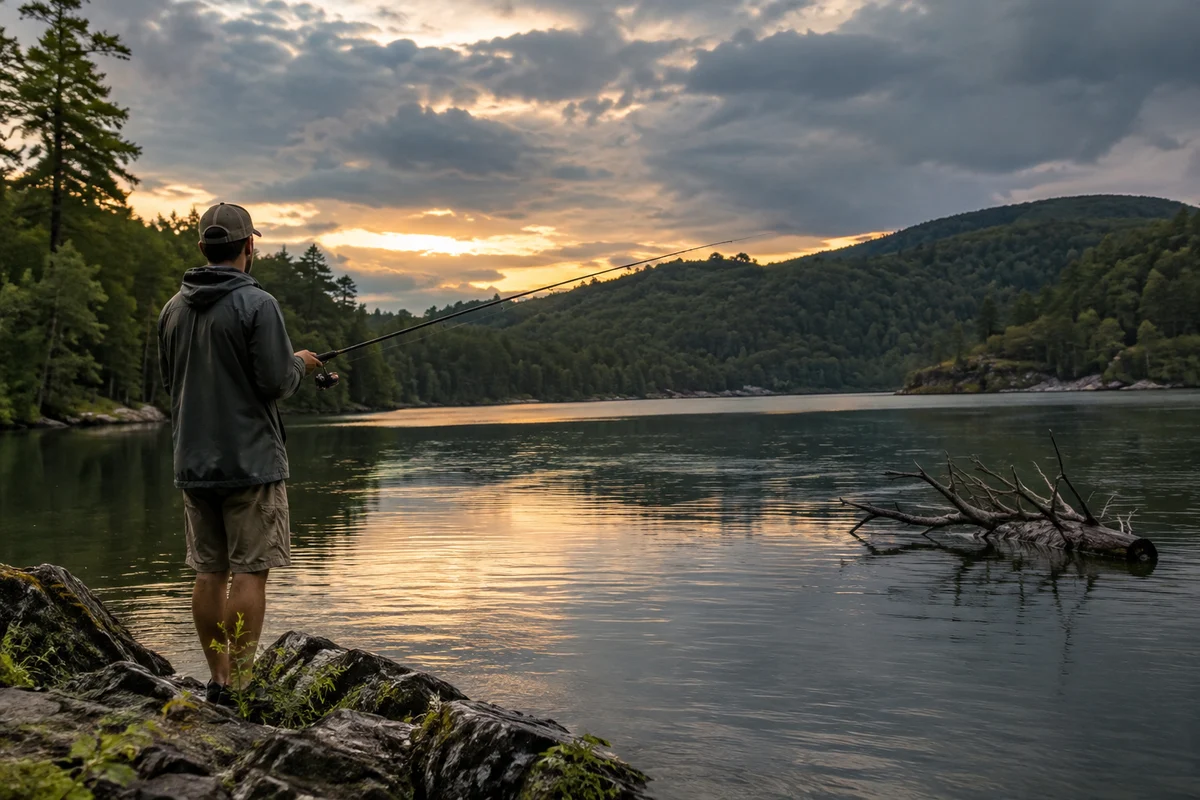
Fishing position changes the calculation. A seated kayak angler has less room to sweep a long rod than someone standing on a broad boat deck. A bank angler may need extra length to reach over shoreline plants, but tree limbs can make that same length a liability. Before buying, picture your actual casting arc and where the rod tip will travel.
Casting or spinning: pick the system you can control
Many dedicated frog setups use a baitcasting reel because it offers direct control and pairs naturally with heavier line and powerful rods. But a baitcaster requires practice: poor spool control can create backlashes, particularly when casting into wind or trying to send a light lure a short distance. A spinning setup can be easier for some anglers to cast, especially with lighter frogs, although the available rod and line combinations may differ.
Choose the system you can cast accurately and safely. A powerful setup does not help if it sends the frog into branches or makes you avoid tight targets. If you are new to baitcasting, practice with a familiar lure in an open area before fishing around people, boats or fragile cover. Follow the reel and rod makers’ guidance for line capacity and lure range.
Frog fishing often uses braided line because it has little stretch and can cut through some vegetation better than many other lines. That does not make braid suitable for every situation: knots, line diameter, vegetation, reel capacity and local conditions all matter. Match the line to the rod and reel recommendations, and inspect it for damage. The rod itself should be selected to work with the line and cover as a system.
A practical selection framework
Use this table to narrow the field. It describes general tendencies, not product specifications or guaranteed performance.
| Fishing situation | Rod direction to consider | Main trade-off |
|---|---|---|
| Small frogs, open pockets, limited casting space | Medium-heavy power; manageable length; responsive tip | Easier placement, less reserve for the heaviest cover |
| Mixed pads and moderate weeds | Heavy power; fast or moderately fast action; about seven-foot class | Broad utility, but “heavy” varies among makers |
| Dense mats or thick vegetation | Powerful heavy model; length you can cast accurately | More control may mean more fatigue and less finesse |
| Kayak or seated fishing | Shorter, balanced rod that clears the deck | Easier handling, reduced reach compared with longer rods |
| Bank fishing under trees | Length chosen around the actual overhead clearance | More reach can conflict with a safe casting arc |
Before settling on a model, answer these questions:
- What is the thickest cover I regularly fish? Select for common conditions, not a rare extreme, unless that extreme is the main reason for the purchase.
- What frog sizes do I use? Check that the rod maker’s lure range includes the baits you intend to cast.
- Where do I cast from? Account for branches, a low ceiling, a kayak seat or crowded boat deck.
- Can I cast it accurately for hours? Balance and comfort matter; a rod that is exhausting will likely be used less effectively.
- What line and reel will I pair with it? Confirm compatibility with manufacturer guidance and your fishing conditions.
Set the hook without rushing the strike
A common challenge with topwater frogs is timing. A fish can miss, push the lure or take it under without getting the hooks. Immediately jerking at the first splash may pull the frog away before the fish has a chance to take it. Many anglers wait until they feel weight or see the line move, then make a firm, controlled hookset while keeping the rod and line under tension.
The exact timing depends on the strike and cover. Watch the lure and line, stay ready, and avoid a frantic sweep that puts you off balance. Once connected, use steady pressure to guide the fish away from the thickest vegetation. Do not wrap line around a hand or pull against a snag with your body; braided line can cut skin, and a loaded rod or lure can spring back. Keep bystanders clear when freeing a snag and use appropriate tools where needed.
No rod can compensate for damaged hooks, a poorly tied knot, slack line or a fish that never takes the lure. Check the frog’s hooks for corrosion or deformation, maintain a sound knot, and inspect line regularly. If fish repeatedly miss, consider whether the lure is the right size and condition for the situation, and whether your hookset timing needs adjustment before blaming the rod.
Where a frog fits among bass presentations
Frogs are especially useful when vegetation or other surface cover makes a conventional moving bait difficult to retrieve. They are not automatically the best choice whenever bass are near weeds. If fish are feeding below the surface, a subsurface presentation may be more effective; in other situations, a slower or more subtle bait can help. For anglers comparing approaches, the guide to plastic worm rigs for bass explains several bottom-oriented options, while choosing a spinnerbait for bass covers a moving bait for different cover and conditions.
A frog is one tool in a broader freshwater bass approach. Explore the freshwater bass fishing hub for related techniques and seasonal topics. For a different topwater-style bait, see the overview of the Booyah ToadRunner; its design and retrieve differ from a hollow-body frog, so it is a comparison rather than a substitute in every situation.
Common mistakes when choosing a frog rod
Buying the stiffest rod available. More power can help in heavy cover, but an overly stiff rod can make lighter frogs difficult to cast and reduce comfort. Choose for the cover you actually fish and your ability to control the rod.
Treating rod labels as universal. Power and action terms are not perfectly consistent across manufacturers. Compare models, handle them when possible and check the published lure and line ranges.
Ignoring casting clearance. A long rod that is excellent on open water may be awkward beneath branches or from a seated position. Fit the length to your casting environment.
Choosing by price or reputation alone. A familiar brand name cannot establish how a particular model feels or whether it suits your use. Review current manufacturer information and inspect the rod in person where possible; specifications and availability can change.
Expecting equipment to solve every missed strike. Hook condition, line management, lure placement and timing all matter. Practice and make one adjustment at a time so you can tell what improves your results.
The takeaway
For a starting point, look for a casting rod with substantial power, a fast or moderately fast action and a length you can handle accurately—often around the seven-foot class for general frog fishing. Move toward more power when dense vegetation is routine; favor a shorter, more manageable rod when your casting space is tight. Verify the specific rod’s current specifications with its manufacturer, and match it to your reel, line, frogs and local conditions. The best choice is the one that gives you control without making accurate casts or all-day fishing harder.
Frequently asked questions
What rod power is a good starting point for frog fishing?
Medium-heavy to heavy power is a practical starting range. Choose more power for dense vegetation, while considering lure weight, casting comfort and the specific rod maker’s ratings.
Is a fast-action rod best for frog fishing?
Fast or moderately fast actions are common choices because they combine a responsive tip with a stronger lower section. The feel varies by model, so compare rods rather than relying on the label alone.
How long should a frog fishing rod be?
A rod around seven feet is a useful general starting point for many anglers. Shorten it for tight casting space or a kayak; choose more length only if it improves reach without compromising accuracy.
Can I use a spinning rod for frog fishing?
Yes, if the rod, reel, line and frog are compatible and you can cast accurately. Many anglers prefer baitcasting tackle for heavier setups, but comfort and control are important.
Sources & further information
Consult these primary sources for current regulations, technical information and local guidance.