Lifecard 22 Mag: What to Know About the Folding Handgun
The Lifecard 22 Mag is notable for its folding, card-like form and compact .22 WMR chambering. This guide explains the design in context, what public information can—and cannot—tell you, and the safety and legal questions to check before handling any firearm.
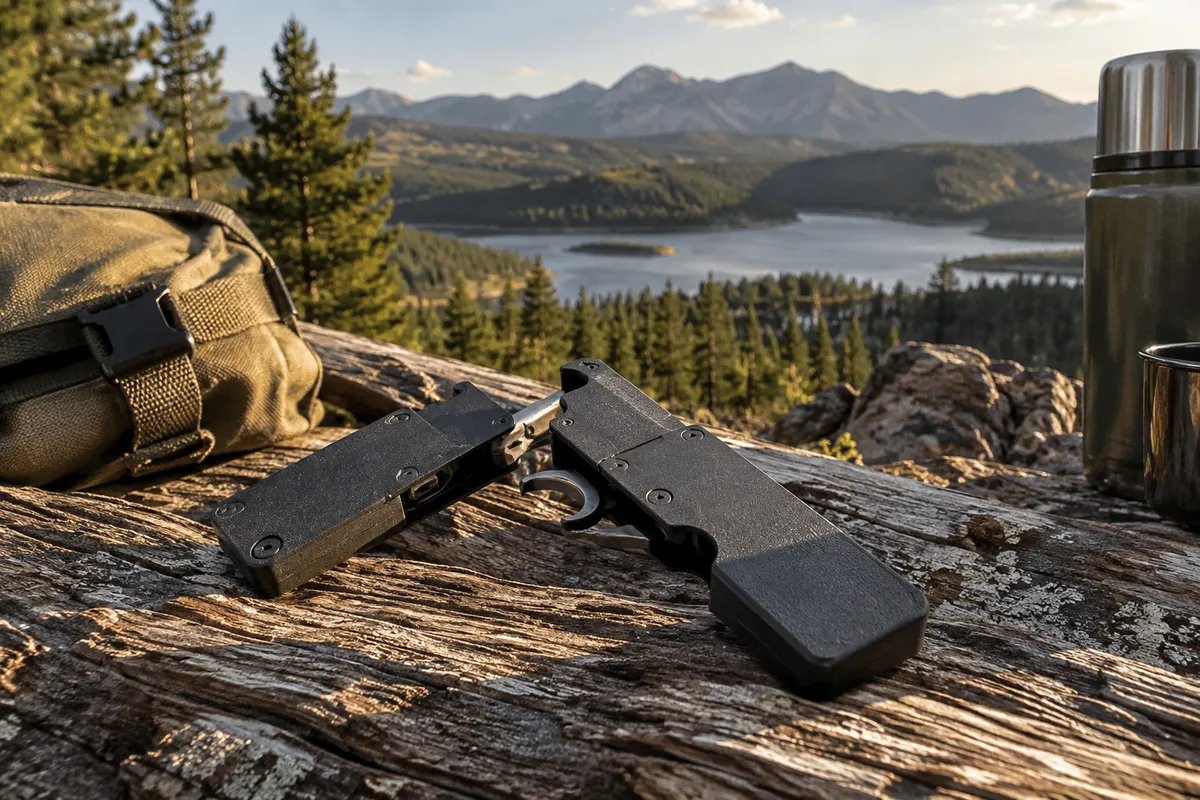
The Lifecard 22 Mag is a small, folding firearm whose unusual shape makes it easy to mistake for a novelty or an ordinary metal object. It is neither: it is a firearm, and its size does not lessen the need for careful handling, secure storage, and compliance with local law. Because product details can change and older announcements may describe a particular version, treat the original owner’s manual and current manufacturer information as the authority for exact specifications.
This article looks at the design at a high level, clarifies what the .22 WMR designation means, and offers a responsible framework for evaluating documentation and safety. For broader context on the site’s informational coverage, see the ODU Magazine guns topic hub. This is not a recommendation to acquire or carry a firearm.
What is the Lifecard 22 Mag?
The Lifecard is a compact, folding handgun design associated with Trailblazer Firearms. When folded, its profile resembles a small rectangular card; when opened, it takes the form of a single-shot handgun. The “22 Mag” name refers to .22 Winchester Magnum Rimfire, commonly abbreviated .22 WMR. It is distinct from .22 Long Rifle (.22 LR), despite the similar caliber designation. Ammunition marked for one cartridge should never be assumed suitable for another firearm or chamber.
A folding format changes how the object is stored and presented, but it does not change its basic status or responsibilities as a firearm. Avoid relying on appearance, informal descriptions, or photographs to identify a particular unit. Confirm the exact model and cartridge designation on the firearm and in its documentation, and ask a qualified professional if markings are unclear.
How does the design differ from a conventional handgun?
The defining feature is the folding construction: the firearm is compact when closed and must be opened into its intended configuration. That makes it unlike a conventional fixed-frame pistol in both shape and handling expectations. It is also a single-shot design rather than a repeating handgun with a multi-cartridge magazine. Those broad distinctions are useful for understanding the product, but they are not a substitute for the manual’s instructions or a hands-on safety course.
| Question | Responsible way to evaluate it |
|---|---|
| Which model is this? | Match markings and model designation to the manual and current manufacturer records. |
| What cartridge does it use? | Verify the exact chambering on the firearm and in its documentation; do not infer compatibility from caliber resemblance. |
| What does the folded form mean? | Treat it as a firearm in every state, including while folded, and follow the maker’s handling guidance. |
| Is it suitable for a specific purpose? | Consider lawful context, training, safe storage, and the firearm’s documented limitations; do not infer suitability from compactness. |
| Are specifications current? | Check the manufacturer’s official information and the manual for the exact version. |
What should you verify in the specifications?
Public product descriptions can help identify a model, but an announcement or retailer listing may be incomplete, outdated, or specific to one production run. Before relying on any specification, compare it against the manual for the exact firearm. Verify the model name, chambering, operating and safety information, and any stated limitations. If the manufacturer has changed a model or discontinued a version, do not assume that later or earlier specifications apply to the one in front of you.
The same caution applies to dimensions and weight: a number without a model year or version may not describe every example. For a product whose compactness is central to its design, precise measurements can be tempting to treat as a complete assessment. They are not. Comfort, safe handling, lawful use, and secure storage require more than a size comparison.
For a neighboring example of how firearm product coverage can focus on documented design rather than conjecture, read ODU Magazine’s overview of the Bergara chassis. For a different kind of firearm design and terminology, see the Benelli Ethos 28-gauge guide. These topics are not direct substitutes for the Lifecard’s manual; they illustrate why model-specific documentation matters.
What safety issues deserve special attention?
Follow the manufacturer’s instructions and established firearm-safety practices. Keep the muzzle pointed in a direction where an unintended discharge would not injure anyone, keep your finger away from the trigger unless you are prepared to fire in a lawful and controlled setting, and identify the firearm’s condition without relying on assumption. If you are unfamiliar with the design, seek qualified instruction before handling it. Do not improvise procedures based on a product photo or a generic online description.
A small firearm can be harder to recognize as a firearm when folded, so secure storage and clear communication matter. Store it locked and inaccessible to children and unauthorized users, with ammunition secured separately where required or recommended. Avoid placing it loose in a pocket, bag, vehicle compartment, or other location where it could be mistaken for an ordinary object or accessed unintentionally. Consult the manual for approved storage and handling guidance; do not use a compact appearance as a reason to relax precautions.
For ammunition, use only the cartridge specified for the exact firearm, as confirmed by its markings and manual. Do not use ammunition simply because it appears to fit or shares a similar number in its name. If ammunition, chamber markings, or the firearm’s condition is uncertain, stop and seek guidance from a qualified gunsmith or the manufacturer.
What laws should an owner check?
Firearm rules vary by country, state, and municipality, and can address possession, transfer, storage, transport, and carry differently. A folding shape does not establish an exemption or a legal category. Check current official state and local rules, and consult a qualified legal professional when the classification or intended use is unclear. Do not rely on an old announcement, forum post, or another owner’s experience as a statement of current law.
If the firearm may be transported, verify the applicable rules for the places of departure, transit, and arrival. Requirements can differ even within one trip. The U.S. Bureau of Alcohol, Tobacco, Firearms and Explosives provides general federal firearms information, while state and local authorities are needed for jurisdiction-specific requirements. This overview is not legal advice.
A practical decision framework
Before handling or evaluating a Lifecard, work through this short checklist:
- Identify the exact firearm. Read its markings and match them with the correct manual; do not infer identity from shape alone.
- Confirm the chambering. Verify that the cartridge designation is explicit and that any ammunition is specified for that firearm.
- Understand the folding design. Read the maker’s instructions and get qualified guidance if any operation or safety feature is unclear.
- Plan secure storage. Choose a locked arrangement that prevents access by children and unauthorized people, and follow applicable storage laws.
- Check current law. Confirm the relevant rules for possession, transport, and any intended use with official sources.
- Be realistic about limits. Compactness and a distinctive format do not by themselves establish suitability, reliability, or safe handling for a particular person or circumstance.
The Lifecard 22 Mag is best understood as a specialized, compact firearm design—not as a harmless gadget. Its visual novelty can invite assumptions, but reliable conclusions come from the exact unit’s markings, its original documentation, qualified instruction, and current law. For any detail that is not clearly established in the manual or current manufacturer materials, treat it as unknown rather than filling the gap with a guess.
Frequently asked questions
Is the Lifecard 22 Mag a .22 LR firearm?
The 22 Mag designation refers to .22 Winchester Magnum Rimfire (.22 WMR), not .22 Long Rifle. Verify the exact firearm’s markings and manual, and never assume the cartridges are interchangeable.
Is the Lifecard 22 Mag a repeating handgun?
It is generally described as a folding, single-shot handgun design. Confirm details and operation for the exact version using its manufacturer documentation.
Where can I check current Lifecard specifications and legal requirements?
Use the manufacturer’s official materials and the manual for the specific firearm. Check current federal, state, and local government sources for laws; requirements vary by jurisdiction.
Sources & further information
Consult these primary sources for current regulations, technical information and local guidance.