Offshore Angler Gold Cup Reel: What to Check
A practical guide to understanding a conventional levelwind reel, checking model-specific details, and deciding whether its condition and capacity suit your saltwater fishing. Since specifications can vary by version, confirm them on the reel or in its manual.
The Offshore Angler Gold Cup reel is best approached as a particular reel to identify and evaluate, not as a guarantee of one fixed set of specifications. Names can cover multiple versions or combinations, and details such as line capacity, retrieve ratio, and drag design should be confirmed from the reel itself or its documentation. Understanding what a conventional levelwind reel does—and what to inspect before fishing—helps you decide whether a Gold Cup is appropriate for your intended saltwater use. For broader context, see the saltwater fishing hub and its related equipment and technique coverage.
What does a conventional levelwind reel do?
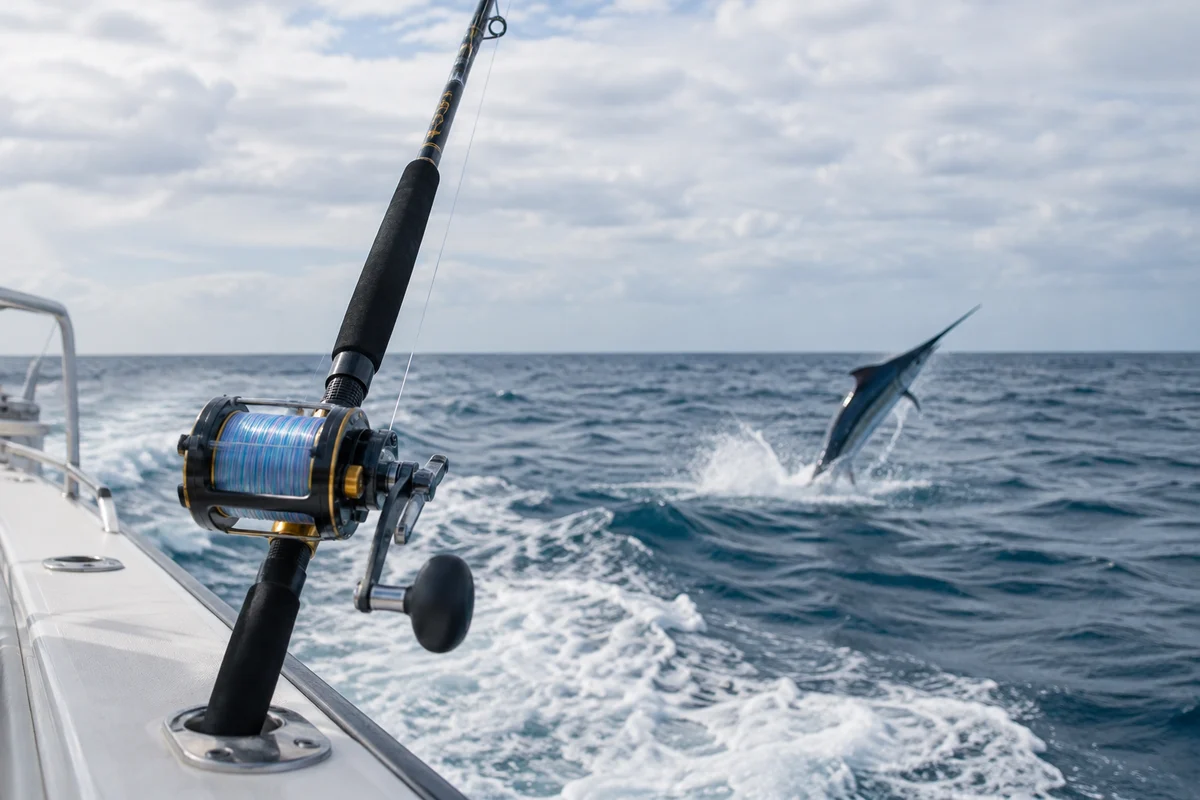
A conventional reel places the spool across the reel body and is commonly held above a rod during use. On a levelwind model, a moving line guide travels across the spool as line is retrieved. That guide helps distribute incoming line more evenly, reducing the need for the angler to guide line from side to side by hand. It does not eliminate the need to check the line lay, especially after a hard run or when line is wound under uneven tension.
This layout differs from a spinning reel, where line comes off a fixed spool and is collected by a rotating bail. Conventional reels are often selected for boat fishing, bottom presentations, trolling, or other situations where a direct connection to the spool is useful. Their handling and controls take some getting used to, and casting performance depends on the reel design, rod, line, and angler technique. A levelwind guide can add convenience, but it is not by itself proof that a reel is suited to every casting method.
A product name alone does not establish whether a specific Gold Cup is a stand-alone reel or part of a rod-and-reel outfit. Compare its actual frame, handle, spool, and markings with the relevant documentation. For a comparison with a different saltwater setup, read the overview of Offshore Angler Sea Lion spinning rod-and-reel combos; a spinning combo and a conventional levelwind reel serve different handling preferences.
How can you identify the exact Gold Cup version?
Start with the markings on the reel: model designation, gear ratio if listed, handedness, and any line-capacity information. Photograph those markings and check them against the manual or manufacturer information for that precise version. If a label is worn or the reel has been modified, avoid treating a similar-looking model’s specifications as a match. Reels can share a family name while differing in details that matter on the water.
Inspect the spool and frame for dents, cracks, corrosion, or signs that the spool rubs the frame. Turn the handle slowly and listen for grinding, clicking that seems irregular, or binding. Check that the levelwind guide moves consistently across its path as the handle turns; do not force it if it sticks. Look for a smooth, even line path through the guide and confirm that the clutch or free-spool control engages and returns in a predictable way.
A brief hand check can reveal obvious problems, but it is not a substitute for a service inspection. If the reel has been stored for a long time, exposed to salt, or feels rough, have a qualified reel service professional assess it before relying on it for a demanding trip. Do not infer service history or present condition from the model name or appearance alone.
What line capacity and line should you use?
Use capacity figures only when they are confirmed for the exact model and line type. A stated capacity for one diameter or material does not transfer directly to another: braid and monofilament differ in diameter, and different line brands may vary as well. If no reliable capacity marking or manual is available, do not fill the spool based on a guess. An underfilled or overfilled spool can affect handling, while insufficient usable line can be a poor match for a fish capable of a long run.
Choose line for the intended technique, likely fish, structure, and local regulations—not simply for the largest breaking-strength number that fits. Check the line for abrasion, flattened spots, discoloration, and damage near knots. Replace compromised line, and spool new line with steady tension so it sits evenly. After winding, confirm the spool turns freely and that the levelwind lays line across it without piling repeatedly against one edge.
The rod, reel, line, terminal tackle, and drag work as a system. Follow the rod’s line guidance and the reel’s verified limits, and avoid pairing components whose ratings conflict. When fishing from a boat, keep the working line clear of sharp edges and neighboring gear. For ideas about a different saltwater presentation, the Coyote spoon for saltwater salmon illustrates how lure choice and target species shape the rest of a setup.
How should you evaluate the drag and retrieve?
The drag allows line to leave the spool under resistance. A sound assessment begins with the reel’s own documentation, not an assumed maximum setting. With the reel secured and the line routed correctly, test the drag smoothly and cautiously; it should not surge or lock unexpectedly. Avoid pulling hard against a bare spool or putting fingers near moving parts. If the drag is inconsistent, contaminated, or difficult to adjust, arrange service rather than relying on it for a fish.
A retrieve ratio, when provided, describes how much line the spool takes up per handle turn under specified conditions. It does not alone tell you how easy the reel will feel under load, nor does it establish a universal best use. Handle length, spool size, gearing, line fill, and the fish’s resistance all affect effort and line recovery. Confirm any ratio from model-specific documentation, and consider whether the retrieve feels manageable for the presentations you plan to fish.
For record-related questions, distinguish equipment suitability from claims about a fish or catch. The International Game Fish Association publishes rules and information for its record program; anglers pursuing a potential record should check the current category requirements, tackle rules, and documentation process directly rather than relying on a reel label.
What maintenance matters in saltwater?
Salt and grit can shorten the useful life of fishing equipment. After a trip, follow the reel maker’s cleaning guidance. In general, remove visible salt and debris with a gentle fresh-water rinse, avoid directing high-pressure water into openings, and dry the reel before storage. Do not immerse it or apply lubricant indiscriminately: cleaning and lubrication points vary, and excess lubricant can attract grit or affect drag components.
Check the line guide, handle, spool, and accessible fasteners for residue or corrosion. Store the reel dry, with the drag setting treated according to its manual. If the reel has been submerged, feels rough, or shows corrosion around moving parts, seek a proper inspection. A rinse is useful routine care, not a repair for internal damage.
Fishing from a boat adds separate safety responsibilities. Secure rods and loose tackle, keep lines away from passengers, and use appropriate flotation and boating safety practices. The U.S. Coast Guard’s boating safety resources provide general guidance; local rules and conditions still matter.
Is the Gold Cup right for your fishing?
Match the exact reel’s verified capacity and condition to the fishing you actually do. Consider whether you need a levelwind for controlled line retrieval, whether the rod and reel balance comfortably, and whether you can operate the controls without distraction. If your plan relies on long casts with light lures, compare the reel’s documented intended use and casting design rather than assuming every conventional reel behaves alike. For boat-based work where a direct spool connection and a levelwind suit the presentation, those features may be useful.
Before a trip, confirm that the reel is assembled correctly, the drag functions consistently, the spool has suitable line, and the guide moves freely. Practice handling it in a controlled setting before fishing near other people or obstacles. If the exact version, service condition, or capacity remains uncertain, pause and verify those points; the product name cannot answer them by itself.
A quick pre-trip checklist
- Read the reel’s markings and confirm the exact model in reliable documentation.
- Check spool capacity and line compatibility rather than estimating from appearance.
- Inspect the frame, spool, guide, handle, clutch, and drag for damage or irregular movement.
- Confirm that rod, line, and reel guidance are compatible for the planned technique.
- Clean and store the reel according to the manufacturer’s instructions, and arrange service if it binds or feels rough.
A Gold Cup reel’s value to your fishing comes down to its verified version, condition, and fit for the job—not the name alone. Treat the levelwind as one useful design feature, check the details that affect performance, and choose your setup around the fishery and method.
Frequently asked questions
Is the Offshore Angler Gold Cup a spinning reel?
The Gold Cup name is associated here with a conventional levelwind reel, but confirm the exact version from its markings and documentation. Conventional and spinning reels have different spool and line-retrieval designs.
Where can I find the Gold Cup reel’s line capacity?
Check the markings on your exact reel and its corresponding manual or manufacturer documentation. Capacity depends on line type and diameter, so do not assume a figure from a similar model applies.
Can a levelwind reel be used for saltwater fishing?
A conventional levelwind reel may suit some saltwater methods, provided its verified specifications, condition, rod, and line match the intended use. Rinse and maintain it according to the maker’s guidance.
Sources & further information
Consult these primary sources for current regulations, technical information and local guidance.