Florida cichlid fish: Identify Mayan Cichlids and Check Records
A practical guide to recognizing Mayan cichlids in Florida, understanding their place in local waters, and checking a state-record claim without relying on an unverified headline.
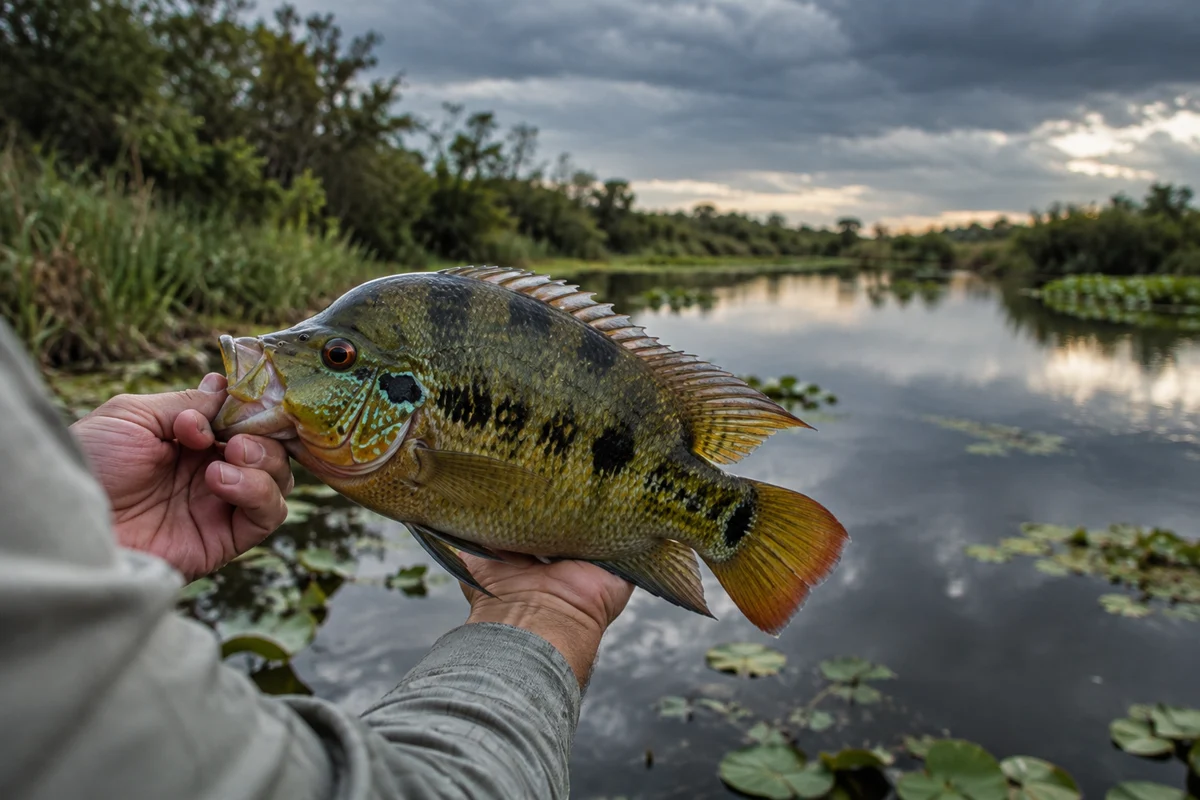
Florida cichlid fish can refer to several introduced or aquarium-associated cichlids, but the species most often meant in Florida fishing discussions is the Mayan cichlid. Its distinctive tail-base spot and barred body make it recognizable, yet identification alone does not establish a state record. If you have seen a claim about a “new state record,” treat it as a lead to verify—not as confirmation—until the species, measurement, catch details, and official record category are documented by the responsible authority.
For anglers, the useful questions are straightforward: Which fish is it? Where does it fit in Florida waters? What does an official record require? The answers help separate a plausible identification from a verified record while keeping attention on responsible fishing and accurate reporting.
Which Florida cichlid is usually called a Mayan cichlid?
The Mayan cichlid, commonly identified by the scientific name Mayaheros urophthalmus (also encountered in older references under a different genus), is a warm-water cichlid native to parts of Central America and Mexico. In Florida, it is an introduced fish. “Florida cichlid” is not a precise species name, so an angler should avoid assuming every cichlid-shaped fish belongs to this species. Aquarium releases and other nonnative cichlids can complicate casual identification.
Mayan cichlids are often recognized by a dark, eye-like spot near the base of the tail and a series of dark vertical bars along the sides. Color can vary with size, condition, behavior, and surroundings, so no single color description should carry the identification. A clear photograph of the entire fish, including its side and tail base, is more helpful than a close-up of one marking. If the fish is unusual or the record stakes are meaningful, seek an identification from a fisheries authority rather than relying on a social-media caption.
For broader freshwater context and related panfish coverage, visit the freshwater panfish fishing hub. The hub is a subject guide, not a claim that Mayan cichlids are native panfish or belong to every state’s panfish record category.
Where do Mayan cichlids live, and what do anglers notice?
Mayan cichlids are associated with warm, shallow freshwater and brackish environments. In Florida, suitable habitat can include canals, ponds, lakes, and connected waters, but distribution is not uniform. A report from one waterbody does not establish that the species occurs throughout a region, and a fish seen in an aquarium or isolated pond is not evidence of a wild population nearby.
Anglers may encounter them around cover or near shore, where a compact, deep-bodied fish with side bars can be visible. Habitat and seasonal conditions influence where fish are encountered, so there is no dependable one-location formula. Focus on careful observation: note the waterbody and general conditions, photograph the fish promptly, and avoid moving live fish between waters. Moving fish can spread nonnative species and may violate local rules.
Florida’s fishing guidance and species information should be checked through the Florida Fish and Wildlife Conservation Commission, especially when identification, harvest rules, or reporting requirements matter. Regulations can change, and rules for one species or waterbody should not be assumed to apply everywhere.
How can you distinguish identification from a state-record claim?
A state-record claim has at least two separate questions: Is the fish correctly identified, and does the catch meet the current record program’s requirements? A photograph can support an identification, but it may not establish weight, measurement, location, date, or compliance with a record category. Conversely, a large fish is not automatically a record simply because it appears larger than other examples an angler has seen.
Start with the exact wording of the claim. Does it say state record, local record, a particular catch-and-release category, or simply a large specimen? Those are different statements. Then identify the agency or organization responsible for maintaining that category. Florida’s official state record rules and listings are the right reference for a Florida claim; an international record organization is relevant only if the claim concerns its own program.
Do not infer that a headline about a “new state record” is verified from its wording alone. The title may be old, incomplete, or repeated without the underlying application. This article does not confirm a particular Mayan cichlid record or holder. For comparison, the Pennsylvania black crappie record discussion illustrates why a species name and state context matter when readers interpret record coverage; its subject is a different fish and it does not validate a Florida cichlid claim.
What evidence should anglers gather for a record application?
Requirements differ among programs, so read the current official rules before handling or releasing a potential record fish. Many programs ask for clear identification, a verified weight or measurement, details about where and when the fish was caught, and information about the method and witness. The exact evidence, forms, deadlines, and eligible categories are program-specific; do not rely on a checklist copied from another state or organization.
If weighing is part of the process, use equipment and procedures accepted by the program. Keep the fish in good condition, avoid delaying care for photographs, and follow the authority’s instructions about witnesses or verification. Take images that show the whole fish and distinguishing features without obscuring the tail or body. Record notes immediately rather than reconstructing details later. Never alter a scale reading, measurement, photograph, or location description.
A release-based category may use different evidence from a weigh-in category. Some programs may require a measurement, a witness, or a prescribed photo angle; others may not offer that category for the species. Check first. If a claim has already circulated, look for the official listing or confirmation rather than treating reposts as independent verification.
How should anglers handle and report a cichlid catch?
Use ordinary fish-handling care: wet hands before handling, support the body, keep the fish out of water only as long as necessary, and use suitable tools to remove a hook safely. If you do not know whether the fish is native or regulated, avoid transporting it alive to another waterbody. Follow posted rules and current state guidance for harvest, possession, and disposal. Do not release aquarium fish or bait into public waters.
A useful field note includes the date, general location, habitat, fish length if measured, and photographs from more than one angle. Keep exact location details private if sharing a post could encourage pressure on a sensitive spot. If you believe the species may be unusual or the catch has record potential, contact the appropriate Florida authority and ask what documentation is needed before making a public claim.
Anglers looking for practical Florida freshwater context can also read these Florida panfish fishing tips. The advice is relevant to fishing preparation, but species identification and legal requirements should still be checked independently for the water and fish in question.
What should readers take away from a “new record” headline?
Treat the headline as a prompt to verify, not proof. Confirm the fish’s identity, determine which record program and category are involved, and consult that program’s current official listing or rules. A state record and an organization’s broader record are not interchangeable, and an apparent match in size does not settle eligibility.
Mayan cichlids are identifiable, interesting Florida catches, but a responsible account keeps known facts separate from assumptions. Use good photographs, accurate notes, and official guidance; avoid repeating a holder, weight, or date unless an authoritative record source confirms it. That approach serves anglers better than turning an unverified claim into a supposed historical fact.
Frequently asked questions
What is the most common Florida cichlid meant by “Mayan cichlid”?
It usually refers to the Mayan cichlid, *Mayaheros urophthalmus*. A tail-base spot and dark side bars can help with identification, but photos or expert review may be needed to distinguish it from other cichlids.
Is a Florida Mayan cichlid state-record claim confirmed by a headline?
No. Verify the fish, record category, documentation, and listing with the authority that maintains the relevant Florida record. This article does not confirm a particular record or holder.
What should I do if I catch a cichlid I cannot identify?
Photograph the whole fish and distinguishing features, note the general location, and consult Florida Fish and Wildlife Conservation Commission guidance. Do not move a live fish to another waterbody, and check current rules before harvest or release.
Sources & further information
Consult these primary sources for current regulations, technical information and local guidance.