How to Use Christmas Trees for Fish Habitat
Evergreen trees can provide shelter and feeding structure for fish, but successful habitat projects depend on site conditions, permissions, and careful placement. Use this practical guide to evaluate whether a tree-reef project suits your waterbody.
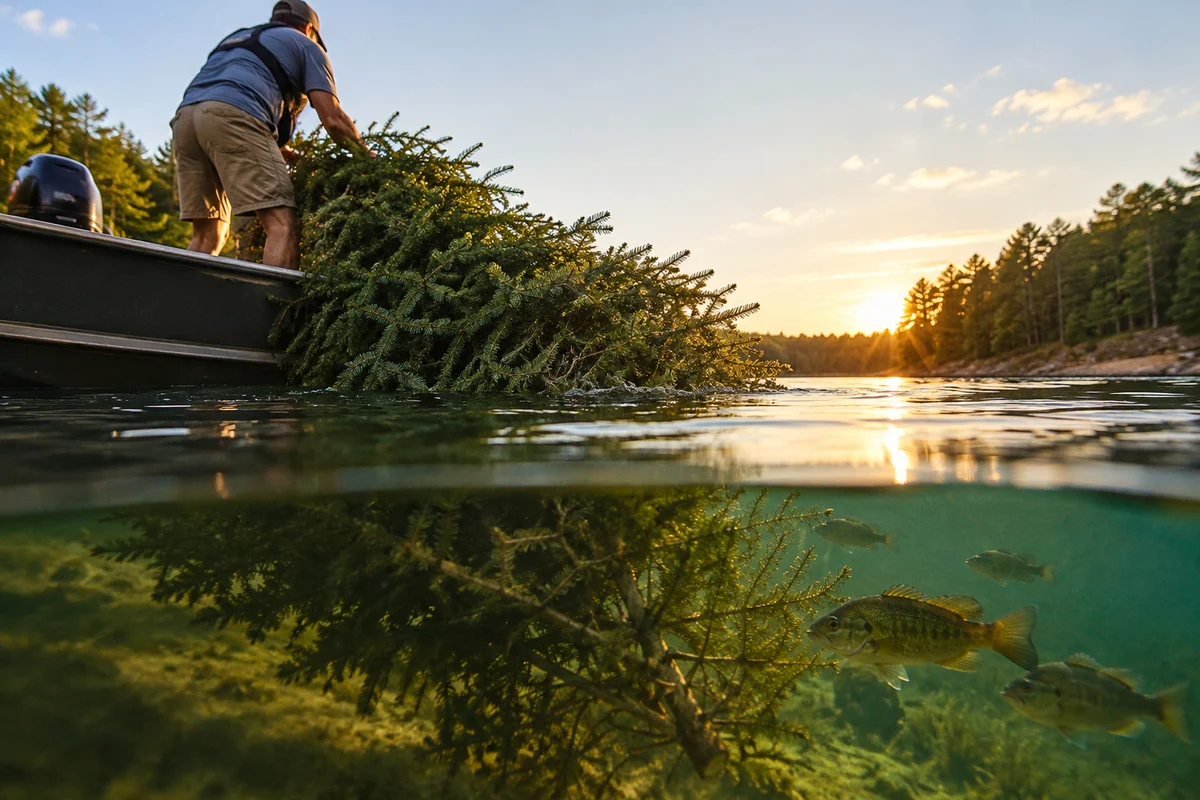
Christmas trees for fish habitat can turn a seasonal material into underwater cover, but simply sinking a tree does not guarantee better fishing or healthier water. The best projects are planned with a lake manager or landowner, use appropriate trees and anchoring methods, and account for water depth, navigation, water levels, and local rules. A tree that is useful in one cove may be ineffective—or hazardous—in another.
This guide explains what submerged trees do, how to assess a site, and what to ask before organizing a habitat project. Local requirements differ, so treat agency guidance and written permission as essential rather than optional.
What submerged Christmas trees do for fish
A submerged evergreen adds branches and small spaces to an otherwise open or simplified underwater area. Depending on the waterbody and season, that structure may provide refuge for small fish, places for invertebrates to live, and ambush or feeding cover for larger fish. Anglers may also find fish concentrated around a well-sited structure.
The effect is local, not magical. A tree does not create a self-sustaining fish population, correct poor water quality, or replace healthy shorelines, wetlands, and aquatic vegetation. Fish use depends on species, temperature, depth, existing cover, water clarity, and the life stage of the fish. An individual tree can also lose branches, shift, or become buried as conditions change.
Habitat projects are most useful when they address a documented lack of structure and are part of a broader fisheries or lake-management plan. For more conservation context, see our conservation and outdoor stewardship hub.
Start with permission and a clear purpose
Before collecting trees or choosing a location, identify who manages the water and its bed. A public lake may involve a state wildlife or fisheries agency, a municipality, a reservoir operator, or more than one authority. On private water, obtain the owner’s permission. Ask specifically whether placing woody material requires a permit, whether there are restrictions on collection or anchoring, and who is responsible for future maintenance.
Then define the project’s purpose. Is the goal to add nearshore cover for juvenile fish, improve a particular fishing area, or support a larger habitat plan? The purpose helps determine whether trees are appropriate at all. A fisheries biologist may recommend a different type of structure, restoration of shoreline vegetation, or no intervention if natural habitat is already adequate.
Do not assume that a familiar community tradition is automatically authorized. Rules can differ by waterbody and may address tree species, attachment materials, location, access, and seasonal timing. Ask for site-specific direction in writing when possible.
Choosing a suitable site
A good location is selected for ecological function and public safety together. Managers may consider depth, bottom type, seasonal water-level changes, nearby vegetation, existing fish habitat, boat routes, swimming areas, and access for installation. The correct depth is not universal: the usable zone changes with lake levels, species, and local conditions.
Avoid placing structure where it could obstruct a channel, ramp, dock, swimming area, or commonly used route. Also avoid sensitive habitats and sites where placement could damage aquatic plants or disturb spawning areas. A tree near shore may be easy to install, but ease alone is not a sound siting criterion.
| Site question | Why it matters | What to do |
|---|---|---|
| Is the placement authorized? | Unapproved material can create legal and management problems. | Confirm the responsible manager and obtain permission before work begins. |
| Is there a demonstrated habitat need? | Added cover may have little value where habitat is already abundant. | Ask a fisheries professional to assess the site and project objective. |
| Could it affect navigation or recreation? | Branches or shifting anchors may create hazards. | Keep clear of marked routes, access points, swimming areas, and infrastructure as directed. |
| Do water levels or currents change substantially? | A structure can become exposed, move, or be stranded. | Evaluate seasonal conditions and use the manager’s placement guidance. |
| Can the project be monitored? | Failed or displaced structures need follow-up. | Record approved locations and assign a responsible contact for checks. |
This framework is a planning aid, not a substitute for local maps, permits, or agency instructions. A manager may rule out a seemingly convenient site after considering underwater features that are not visible from shore.
Preparing trees and materials
Use only materials accepted by the waterbody manager. Many projects favor untreated, undecorated trees, but local rules govern what is acceptable. Remove ornaments, lights, wire, plastic, tinsel, and any other non-natural material. Do not use a tree treated with chemicals, and do not collect trees from land or a shoreline without permission.
Ask the manager what evergreen species are suitable and whether trees should be trimmed or left intact. Branch density affects how fish can use the structure, but overly large or dense material may be difficult to handle and anchor. Avoid adding concrete, metal, or other ballast unless the managing authority explicitly approves the material and method. Improvised weights can introduce hazards, damage habitat, or fail to hold the tree in place.
The manager should specify how structures are secured, how far apart they belong, and whether any identifying marker is required. There is no one-size-fits-all spacing or anchoring recipe: wind, current, depth, bottom conditions, and water-level variation all matter. Keep installation within the approved plan rather than adapting it on the water.
Installation, safety, and follow-up
Organize work with a designated project lead and a clear division of responsibilities. Use appropriate personal flotation devices and safe lifting practices, and follow boating and cold-water safety rules. Do not enter the water or handle heavy, unstable loads in conditions beyond the team’s training and equipment. If a project needs specialized boats or lifting gear, involve qualified operators.
Place trees only at approved coordinates and by the approved method. Avoid dropping material into water from a moving boat or leaving loose branches where they can drift. After placement, make a simple record of the date, location, number of structures, and the responsible contact. Share that information with the lake manager; it helps future crews avoid duplicate work and assess whether the project remains in place.
Follow-up matters. Storms, drawdowns, changing water levels, and decay can alter a structure. Ask who will inspect the site and what should happen if material moves or becomes exposed. Do not retrieve or relocate a submerged structure without authorization. If any part becomes a navigation or public-safety concern, notify the responsible manager promptly.
What to expect—and what not to claim
Fish may use a new structure quickly, slowly, seasonally, or not in a way that is obvious to a casual observer. Catching fish nearby is not, by itself, proof that the project increased the lake’s fish population. Reliable evaluation requires a suitable comparison or monitoring plan and expertise in interpreting the results.
Likewise, one small habitat installation should not be presented as a solution to broader problems such as pollution, erosion, invasive species, or loss of wetlands. For wider conservation issues, our overview of endangered fish species explains why habitat quality and species pressures vary across systems. Ocean habitat challenges differ from inland-lake projects; our guide to ocean cleanup inventions covers another part of the conservation picture.
The strongest projects are modest in their claims: they add a specific kind of cover at a suitable place, under appropriate oversight, and then evaluate whether it remains useful. If the waterbody already has abundant natural structure, protecting that habitat may be more valuable than adding trees.
A simple go/no-go checklist
Proceed only when each answer is clear:
- Permission: The landowner and waterbody manager have approved the project and location.
- Purpose: A knowledgeable fisheries professional has identified a habitat need.
- Materials: The tree, preparation, ballast, and attachment method meet local requirements.
- Siting: Navigation, recreation, sensitive habitat, and water-level changes have been considered.
- Safety: The crew, equipment, weather plan, and installation method are appropriate.
- Stewardship: Someone is responsible for documenting and reporting the structure’s condition.
If any item is unresolved, pause and ask the manager rather than improvising. That small step can prevent a well-intentioned project from creating a hazard or harming the habitat it was meant to support.
Frequently asked questions
Are Christmas trees good fish habitat?
They can add underwater cover and may be used by fish and aquatic organisms. Their value depends on the waterbody, site, species, and project design; they are not a substitute for broader habitat protection.
Can I sink a tree in a public lake on my own?
Do not assume you can. Contact the waterbody manager first, confirm permits and placement rules, and follow the approved plan.
Should decorations or wire be left on the tree?
No. Remove decorations, lights, wire, plastic, and other non-natural items. Confirm with the manager what tree preparation and materials are allowed.
How deep should a tree reef be placed?
There is no universal depth. The appropriate location depends on the waterbody, water levels, fish habitat goals, navigation, and local management guidance.
How can I tell whether the project worked?
Ask the manager about monitoring before installation. Fish observations or angler catches alone do not establish that a project increased fish populations or improved the whole waterbody.
Sources & further information
Consult these primary sources for current regulations, technical information and local guidance.