Z-Man Mag SwimZ for Redfish: Rigging and Retrieve
A practical, conditions-first guide to fishing a Z-Man Mag SwimZ for redfish. Learn how to rig it straight, choose a safe working depth, and adjust your retrieve without assuming one setup fits every flat or tide.
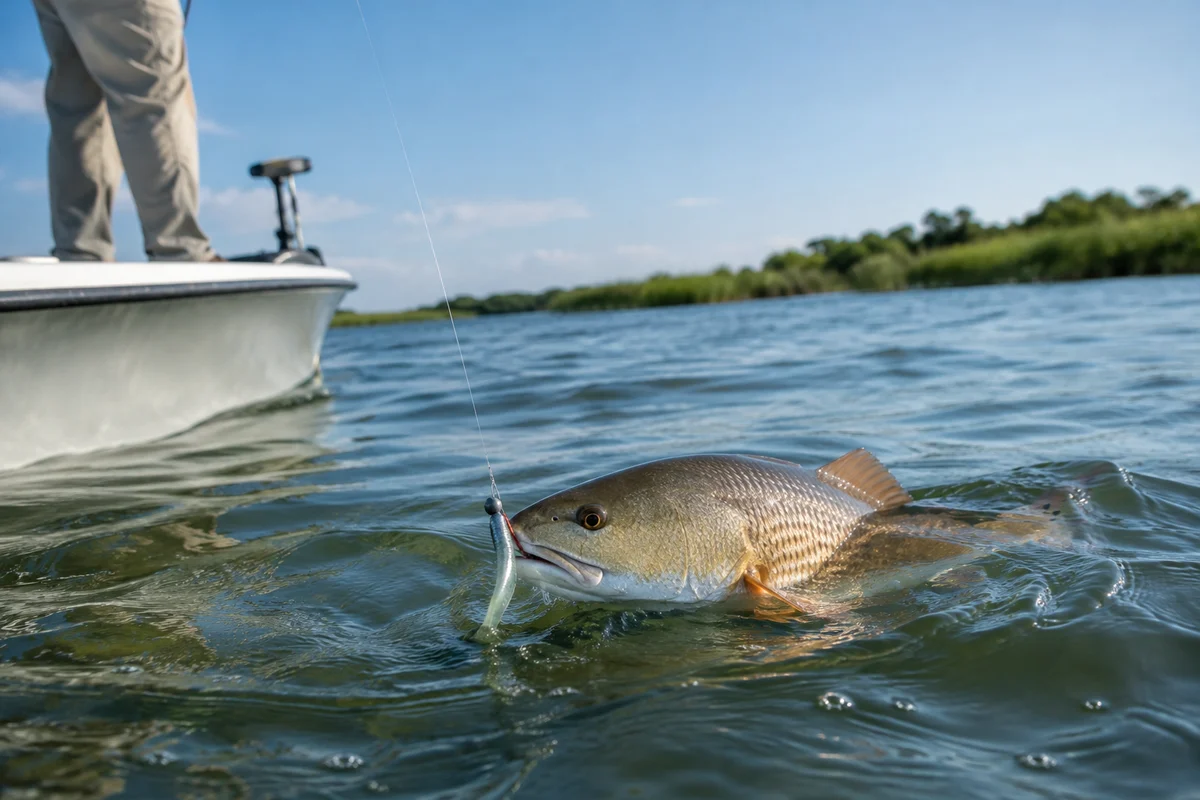
The Z-Man Mag SwimZ redfish setup is best treated as a flexible search presentation, not a magic lure-and-hook combination. A large paddletail can cover water and show a fish a visible moving profile, but the right hook, weight, and retrieve depend on depth, current, cover, and the exact soft-plastic model in your hand. Start by checking the package and hook maker’s guidance, then make small adjustments based on how the bait swims in the water.
This guide focuses on practical, non-brand-specific principles for pairing a Mag SwimZ-style paddletail with a ChinlockZ-style weighted swimbait hook. Product names can span different sizes and revisions, so do not infer compatibility from the name alone. Match the hook to the bait’s body length and thickness, and verify the model’s published specifications before fishing.
What makes a Mag SwimZ useful for redfish?
A paddletail produces movement as water flows over its tail. That makes it useful when you want to search a shoreline, channel edge, grass margin, or open flat with a steady retrieve. Compared with a stationary presentation, a swimming lure lets you cover a stretch efficiently and vary speed to find where fish are feeding.
Redfish may hold in shallow water, along deeper edges, or around structure, and local conditions can change quickly. The lure’s value is its adjustability: you can vary retrieve speed and depth without changing the basic presentation. It is not proof that fish are present, and a lure’s action does not guarantee a strike.
Before fishing, check local rules and conditions. The NOAA Fisheries site provides federal marine-fisheries information, while state agencies publish local seasons, size limits, area restrictions, and other regulations. The saltwater fishing hub is a useful starting point for related coastal-fishing topics.
How do you choose a ChinlockZ-style hook?
Choose the hook based on the actual bait and the water you plan to fish—not a general assumption that every Mag SwimZ and ChinlockZ pairing is interchangeable. Check the manufacturer’s current package or product information for hook size, weight, and intended bait range. If those details are not available, ask the manufacturer rather than guessing.
A sound fit has enough hook gap for the soft body to compress during a bite, while the point remains clear of the plastic. The bait should sit straight along the hook shank and move freely. A hook that is too small can crowd the body or obstruct the point; one that is too large or heavy can distort the bait’s action or make it sink too quickly.
| Fishing situation | Starting consideration | What to observe |
|---|---|---|
| Shallow, calm flat | Lighter overall presentation, if compatible | Does the lure stay above grass and swim naturally? |
| Moving water or deeper edge | More control may be needed | Can you maintain contact with the intended depth? |
| Sparse grass or scattered cover | A weed-conscious hook profile may help | Does the point remain protected without being buried excessively? |
| Unfamiliar bait-and-hook pairing | Confirm maker guidance first | Is the bait straight, unobstructed, and stable on a short test retrieve? |
This is a decision framework, not a promise that a specific hook size or weight will suit every bait. Product versions, body dimensions, and conditions vary.
How should you rig and test the swimbait?
Use the hook maker’s directions for the exact model. Align the bait carefully and keep it straight; even a slight bend can make a paddletail roll, track sideways, or lose its intended action. Avoid forcing a hook through the body in a way that tears the plastic or blocks the hook gap. If the bait does not sit properly on the hook, reassess compatibility instead of compensating with a crooked rig.
Before casting repeatedly, lower the rig beside the boat or shoreline and retrieve it a short distance. Watch whether the tail pulses, the body tracks upright, and the lure holds a useful depth. A bait that spins or rolls may be misaligned, damaged, or paired with an unsuitable hook. Correct the rig or try a manufacturer-approved combination.
Keep hooks covered when transporting or handling tackle, and use care when removing a lure from a fish. A dehooking tool and appropriate pliers can reduce hand exposure to sharp points. Follow local handling and release guidance, especially where a fish is protected or must be released.
What retrieve works for redfish?
Begin with a steady retrieve that keeps the lure moving naturally. Then vary one factor at a time: speed, pause length, casting angle, or depth. This makes the result easier to interpret. If the lure is racing above the fish’s likely zone, slow down or use a compatible heavier presentation. If it drags through grass or repeatedly contacts bottom, speed up, change the casting angle, or select a lighter option where the maker’s guidance allows.
On a flat, cast beyond likely feeding lanes and bring the lure across them rather than directly toward a fish whenever possible. Near a deeper edge, cast along the contour to keep the bait in the zone longer. In current, a cast across or slightly upstream can help the lure travel naturally through the flow; adjust based on how quickly it swings and sinks. These are starting approaches, not fixed rules for every tide or shoreline.
Watch for signs beyond strikes: baitfish movement, a change in water clarity, current seams, or fish activity. If the presentation repeatedly catches grass or debris, adjust its path instead of making blind repeated casts. For context on coastal species and fishery reporting, see NOAA Fisheries; for broader angling records and verification topics, the black drum record discussion shows why careful identification and documentation matter when a catch becomes a claim. It is a separate species and not a guide to redfish tactics.
What should you check when the lure does not swim right?
Use this quick field checklist:
- Confirm the match. Compare the exact bait and hook models with current manufacturer information.
- Check alignment. The bait should lie straight, without a twist or kink.
- Inspect the tail and body. Damage, tears, or a bent tail can affect action.
- Test beside you. Make a short retrieve before committing to a long cast.
- Change one variable. Alter speed, depth, or casting angle separately so you can identify what helped.
- Respect the setting. Grass, current, depth, and water clarity change the useful presentation.
If a rig still rolls or feels unstable, stop and correct the setup rather than assuming the fish will respond. Manufacturer guidance should settle product-specific compatibility questions; this article does not establish a definitive model-to-model fit.
How do you decide whether to change presentations?
Give a lure a fair, controlled trial across more than one likely lane, but do not confuse persistence with evidence. If you see fish or bait activity and the lure is swimming correctly, adjust retrieve speed and angle first. If there is no sign of activity, conditions change, or the lure cannot stay in the intended zone, another depth or presentation may be more appropriate. Keep notes on tide stage, location type, clarity, and what the lure actually did; those observations are more useful than a claim that one color or hook is universally best.
A Mag SwimZ-style paddletail is one option in a broader saltwater kit. The striped bass cleaning guide addresses a different part of coastal fishing, while the saltwater fishing hub gathers more relevant reading. For redfish, let the actual water and a verified, straight-swimming setup guide your choices—and check current local regulations before keeping a fish.
Frequently asked questions
Can any ChinlockZ hook be used with a Z-Man Mag SwimZ?
Not necessarily. Check the exact bait and hook model specifications and manufacturer guidance; names alone do not establish size or weight compatibility.
How can I tell if a paddletail is rigged straight?
Make a short test retrieve beside you. It should track upright with a steady tail action, not roll or pull consistently to one side.
Should I use a heavier hook in current for redfish?
Only if it is compatible with the bait and helps keep the lure in the intended zone. Adjust based on depth, current, and observed swimming action rather than a fixed rule.
Sources & further information
Consult these primary sources for current regulations, technical information and local guidance.