How the Biggest Hammerhead Shark Is Verified
Claims about the biggest hammerhead shark are compelling, but record status depends on species identification, reliable measurements, and an accepted record process. This guide explains what evidence matters and how anglers and observers can act responsibly around these powerful, vulnerable fish.
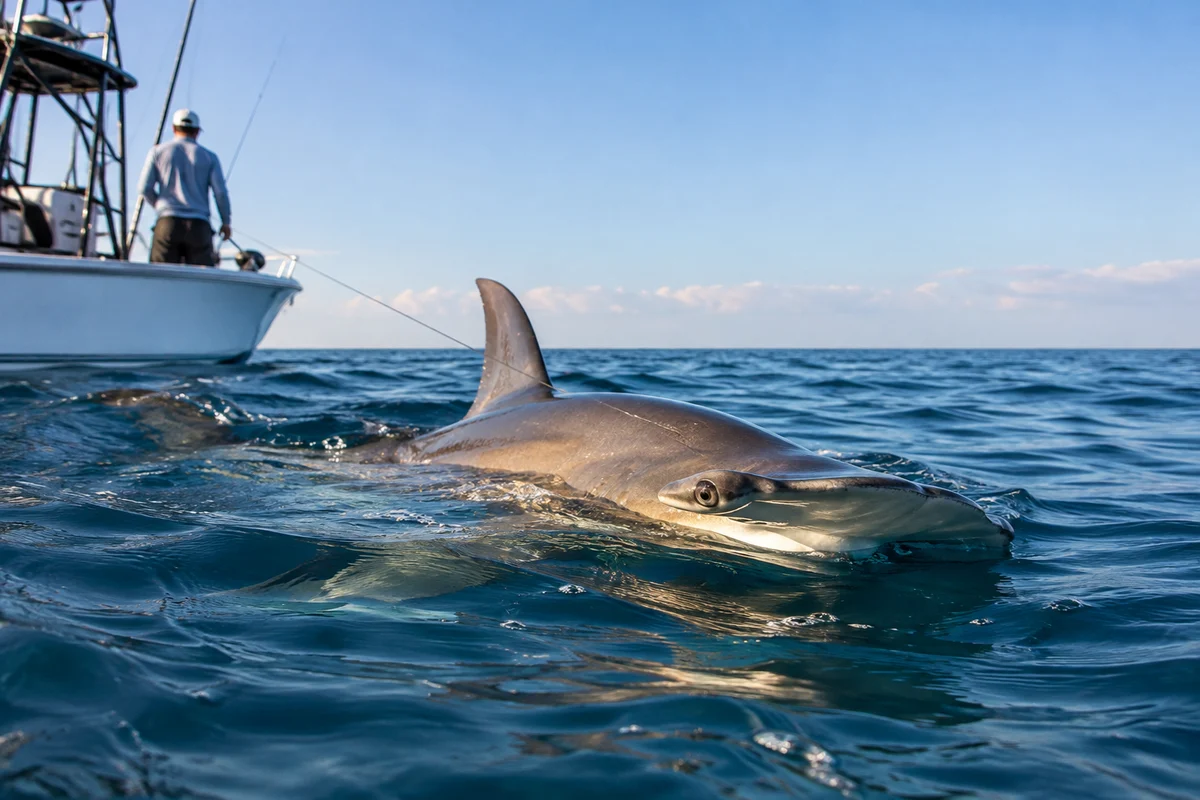
A report of the biggest hammerhead shark can mean several different things: the largest individual ever documented, the largest confirmed by a particular record organization, or simply an exceptionally large shark described in a news account. Those are not interchangeable claims. The answer depends on which hammerhead species is involved, how the animal was measured, and whether an official recordkeeper accepted the evidence.
Hammerheads belong to the family Sphyrnidae, a group that includes multiple species with different ranges and maximum sizes. The great hammerhead (Sphyrna mokarran) is generally recognized as the largest hammerhead species, but that broad biological fact does not establish the size or record status of any particular animal. For anglers, readers, and wildlife watchers, the useful question is not only “How large?” but “What exactly was measured, and who verified it?”
For context on other saltwater species, see our saltwater fishing hub and related guides to sturgeon in Chesapeake Bay and IGFA world records.
Which hammerhead species can be the largest?
“ Hammerhead” is a common name for several related sharks, not a single species. The great hammerhead is the biggest member of the group according to major wildlife and fisheries references. Other familiar species include the scalloped hammerhead and smooth hammerhead. Identifying a shark from a distant photograph or brief encounter can be difficult, particularly when the head shape, fins, or tail are partly obscured.
That distinction matters for records. A large shark cannot be compared fairly with a species-specific record unless its identity is well supported. A reliable report should state the proposed species and explain the basis for identification—ideally clear photographs showing diagnostic features, evaluated by a qualified observer or record authority. A generic label such as “hammerhead” leaves important uncertainty unresolved.
Size estimates also depend on what the source means by length. Total length is generally taken from the snout to the tip of the tail, with the tail in a specified position. A photograph beside a boat, person, or fishing gear may provide scale, but perspective and camera angle can distort apparent size. A visual estimate is not equivalent to a measured record.
How is a record claim verified?
Record organizations use defined rules, and those rules can differ. The International Game Fish Association (IGFA), for example, maintains fishing records under its own eligibility and documentation standards. A scientific measurement, a local reporting record, and an angling record may each be valid in their own context while answering different questions.
Before repeating a “biggest ever” claim, look for these elements:
| Evidence to check | Why it matters | What a careful report should provide |
|---|---|---|
| Species identification | Different hammerhead species have different size ranges | A clear species designation and supporting images or expert review |
| Measurement method | Estimates and measured lengths are not equivalent | The measurement type, endpoints, units, and who took it |
| Record category | Angling, scientific, and encounter records use different rules | The named recordkeeper or institution and category |
| Documentation | A dramatic image alone may not substantiate a record | Dated records, photographs, witnesses, and required forms where applicable |
| Conservation and handling | The pursuit itself can affect a vulnerable shark | Applicable regulations and evidence of responsible, legal handling |
A report can be impressive without being an official record. If a story gives a length but no measurement method, or says “record” without naming the recordkeeper, describe it as a reported estimate rather than a verified world record. If the recordkeeper’s current database does not list the claim, that does not necessarily prove the animal was smaller; it means the claim has not been established through that organization’s process.
For official angling-record definitions and current records, consult the IGFA. Record listings and rules can change, so check the organization’s current guidance rather than relying on an old article or a reposted image.
Why do estimates vary so much?
Large marine animals are not always measured under ideal conditions. A shark may be seen from a boat, photographed at an angle, or released before a precise measurement can be taken. Even a measurement can be difficult to compare if the animal is curved, the tail is positioned differently, or the endpoints are not explained.
Photographs are particularly easy to misread. A fish held close to a camera can appear disproportionately large; a shark farther away can look smaller. Wide-angle lenses amplify that effect. Comparisons with a person, boat rail, or deck are useful only when distance and perspective are reasonably similar. Images can help establish identity and context, but they do not automatically verify length.
Different sources may also use different measurement conventions or round numbers. A claim of “about 13 feet” is a useful description of an estimate, not necessarily a record-quality measurement. Readers should preserve that distinction when sharing a report.
What should anglers do around hammerheads?
Hammerheads are wild predators, and species-specific protections vary by jurisdiction. Rules may cover retention, fishing methods, seasons, handling, or prohibited areas. Check the applicable state, territorial, national, and local regulations before fishing, and do not assume that a rule from one region applies elsewhere. NOAA Fisheries provides federal shark and fisheries information through its official site.
If a shark is encountered while fishing, prioritize people’s safety and the animal’s welfare. Keep a respectful distance when observing from a vessel, avoid crowding or pursuing wildlife for photographs, and follow local requirements for any interaction. When release is legally required or appropriate, use the locally recommended procedures and seek current guidance from the relevant fisheries agency. This article is not a substitute for those rules.
A responsible account can be valuable even when no record is involved. Note the location at an appropriate level of precision, date, conditions, identification confidence, and whether length was measured or estimated. Avoid presenting a guess as fact. If a shark is injured or entangled, contact the proper local wildlife or fisheries authority rather than improvising a risky intervention.
A practical way to assess a “biggest” claim
Use this short decision framework before citing a headline or social post:
- Find the original report. Trace the claim to the person or organization that made it, rather than relying on copied captions.
- Check the species. Does the evidence support great hammerhead or another species, or is it only identified as a hammerhead?
- Separate estimate from measurement. Is the number explicitly measured, and are the endpoints and method stated?
- Identify the comparison. “Largest seen,” “largest reported,” and “official record” mean different things.
- Verify with the relevant authority. Check the recordkeeper’s current rules and listings, and the applicable fisheries agency’s conservation guidance.
- Keep uncertainty visible. If a key detail is absent, call it an unverified report rather than upgrading it to a record.
This approach applies beyond sharks. Our guide to IGFA world records explains why record categories and documentation matter, while sturgeon survey news in Chesapeake Bay offers another example of why a survey result should be read in its actual context.
The bottom line
The great hammerhead is the largest hammerhead species, but a claim about the biggest individual requires more than an impressive picture or a rounded estimate. Species identification, a documented measurement, and a clearly named record category are the essentials. When those details are missing, the most accurate description is simply that a large hammerhead was reported—not that a world record has been proved.
Because rules and record listings can change, verify current information with the record organization and fisheries authorities. Treat the animal as wildlife, follow local law, and share claims with their uncertainty intact.
Frequently asked questions
What is the largest hammerhead shark species?
The great hammerhead (*Sphyrna mokarran*) is generally recognized as the largest hammerhead species. That does not, by itself, identify the largest verified individual.
Does a reported 13-foot hammerhead count as a world record?
Not automatically. A record claim needs species identification, a documented measurement, and acceptance under the rules of a named recordkeeper.
How can I tell whether a hammerhead size claim is verified?
Look for the original report, stated measurement method, supporting identification evidence, and the record organization or authority that assessed it. Otherwise, treat the figure as an estimate or report.
Are hammerhead sharks protected?
Rules depend on the species and location and can change. Check current federal and local fisheries regulations before fishing or interacting with a shark.
Sources & further information
Consult these primary sources for current regulations, technical information and local guidance.