How to Trap Wild Hogs: A Responsible, Legal Field Guide
Effective wild-hog trapping is less about setting a device and more about learning animal patterns, complying with local rules, and capturing the group safely. This guide covers planning, trap choices, monitoring, and the limits of trapping.
Wild hogs can damage crops, habitat, and property, but trapping them is not a one-size-fits-all project. If you are researching how to trap wild hogs, begin by confirming that trapping is allowed where you live and learning which methods, trap designs, and handling requirements apply. Rules can vary by state, county, land ownership, season, and whether the work is recreational or part of a control program.
A successful effort usually combines sign-based scouting, a well-sited corral trap, gradual bait conditioning, and a plan to capture an entire group rather than a few animals. It also requires safe monitoring and a lawful, humane response once hogs are contained. Trapping can reduce local activity, but it does not guarantee eradication: neighboring populations can recolonize an area.
Start with local rules and a clear objective
Before buying, building, or setting a trap, contact the state wildlife agency and, where relevant, the agricultural or animal-health agency. Ask whether landowner permission is required, whether a license or permit applies, what trap specifications are legal, and what rules govern bait, dispatch, transport, carcass disposal, and reporting. Do not assume that a rule for one county or land category applies elsewhere. If hogs are on public land, confirm that trapping is specifically authorized there.
Set a realistic objective with the landowner: protecting a particular field, reducing rooting around a water source, or supporting an agency-led control effort. Record the area affected and the fresh sign you find. A limited objective helps you choose a site and evaluate whether the effort is working without promising that one trap will solve a wider population problem.
For broader context on responsible big-game and wildlife management, see our big-game hunting hub. If your questions involve other game-management claims, our guide to Nebraska record elk explains why exceptional wildlife reports need careful verification rather than assumption.
Scout for repeated use, not just a single track
Look for clusters of fresh rooting, tracks, trails through vegetation, wallows, and droppings. A single sign may be old or incidental; several signs in a compact area can indicate a regular route. Note wind direction, nearby cover, livestock and pets, water, roads, and places where people may encounter the trap. Avoid placing a trap where it could obstruct access or expose the public to a hazard.
Use a trail camera only where lawful and where it will not intrude on neighbors or public users. Camera observations can help establish whether hogs visit consistently, how many appear together, and whether non-target wildlife is also using the location. Do not treat a few images as a reliable population estimate. If other animals repeatedly enter the site, reconsider the location or consult the agency about a selective, permitted approach.
A practical site-selection checklist:
| Check | Favorable sign | Reason to reconsider |
|---|---|---|
| Fresh activity | Repeated tracks and rooting nearby | Only old, scattered sign |
| Group behavior | Several hogs use the area together | A trap would capture only occasional individuals |
| Access | Safe approach for inspection and service | Difficult access or proximity to public traffic |
| Non-target use | Limited evidence of pets, livestock, or protected wildlife | Frequent visits by non-target animals |
| Legal status | Landowner permission and agency rules confirmed | Unclear authority, permits, or trap restrictions |
Choose a trap designed for the job
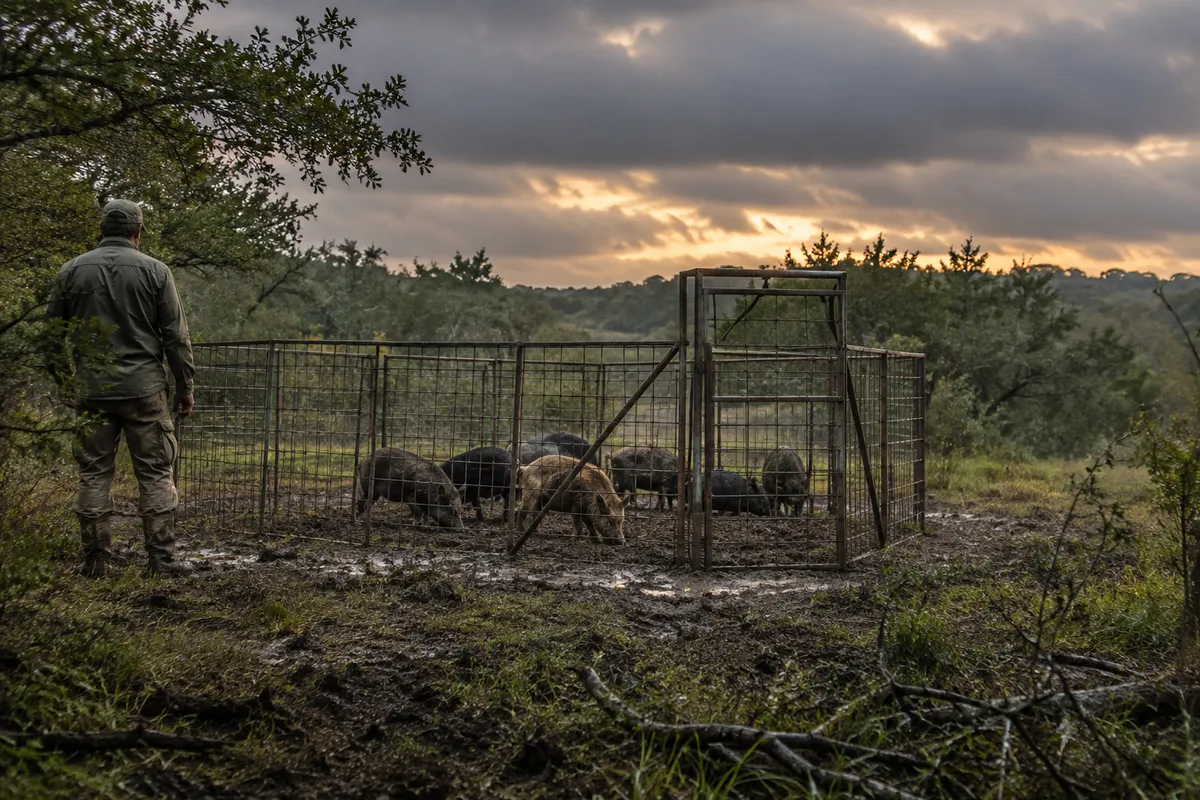
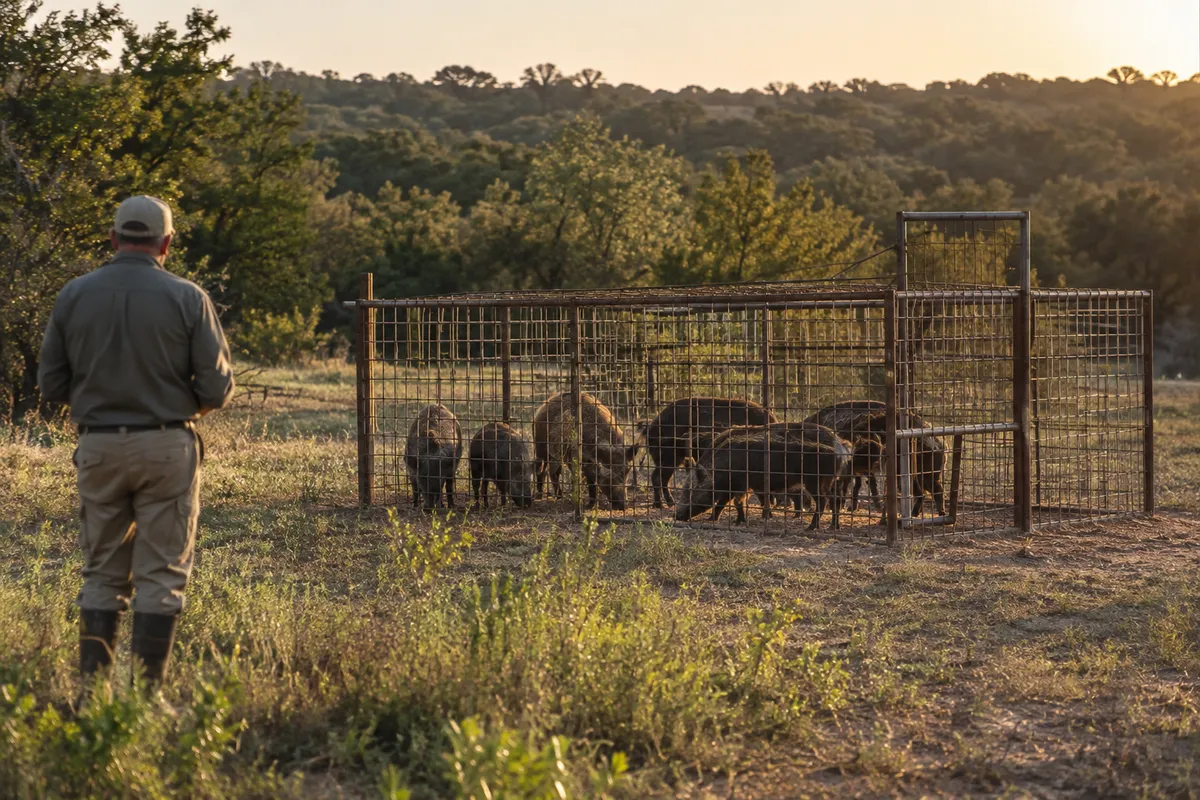
A corral-style trap gives a group room to enter and is often used where whole-group capture is the goal. Panels, gates, and triggering systems vary; select a design allowed by local rules and suitable for the site. A smaller or poorly configured trap may catch only some of a group. Survivors can become wary, making later capture harder.
Inspect the structure before use. Check that the gate operates as intended, the enclosure is stable, and there are no gaps or sharp projections that could injure animals. Follow the maker’s instructions and applicable regulations. Do not improvise mechanisms that could create an uncontrolled hazard, and do not set a trap unless you can monitor and service it as required.
The key decision is not simply “corral or smaller trap,” but whether the design and plan can capture the animals visiting that location while limiting non-target entry. If local conditions or rules make a safe, lawful setup uncertain, pause and seek guidance from the wildlife agency or an experienced local control program.
Condition hogs before setting the trigger
Where legal, bait can help establish a predictable visit. Commonly used bait types vary by location and regulation; agencies may restrict baiting because of disease concerns, wildlife impacts, or conflicts with other management. Confirm what is allowed before placing anything. Keep bait away from water, livestock feed, and public access, and avoid attracting animals to roads or neighboring property.
At first, allow hogs to feed at the site without activating the gate. Use camera observations or other lawful monitoring to see whether the group is entering comfortably and whether all visible animals are present. The aim is not to leave a trap unattended indefinitely: follow any inspection schedule required by law and check it as frequently as practical. Only arm the trigger after evidence suggests the group is using the enclosure consistently. A trigger activated too early can capture a few animals and educate the rest.
There is no universal number of visits or conditioning period. Weather, food availability, disturbance, group size, and local behavior all affect timing. If hogs stop visiting, investigate disturbance, bait access, or a change in their travel route rather than adding more bait without a plan.
Monitor, respond, and handle animals safely
Have a response plan before setting the trap: who will check it, how quickly they can arrive, who is legally authorized to handle the animals, and what lawful disposition is available. Use a camera or other alert system only as a supplement to required physical inspections, not a substitute. Trapped animals can be stressed, and delays can create welfare, safety, and legal problems.
Keep people, dogs, and livestock away from a contained trap. Do not enter the enclosure, reach through panels, or attempt to handle a hog. A trapped animal can move abruptly, and multiple animals may react together. If the trap has captured non-target wildlife, follow agency instructions for that species; do not assume that a generic release procedure is safe or legal.
Dispatch and carcass handling laws differ. Use only methods authorized by the relevant agency and within your training and legal authority. This article does not provide weapon-use instructions. If firearms are involved under local law, follow all firearm-safety rules, keep them securely stored when not in use, and never handle them around an unsecured trap or bystanders. For an overview of how wildlife reports and records should be checked, see our guide to the Boone and Crockett record book; recordkeeping principles are useful, but that resource is not a trapping manual.
What trapping can and cannot accomplish
Trapping can remove animals from a target site, but it is an ongoing management tool, not a permanent boundary. Hogs may move in from surrounding land, and food sources or habitat can continue to attract them. Coordinate with adjacent landowners when possible and ask local agencies whether a broader, integrated approach is recommended. Depending on the problem, that may include exclusion fencing, removing attractants, crop protection, or coordinated control.
Keep a simple log of dates, fresh sign, camera observations, trap status, non-target visits, and actions taken. This helps determine whether activity has declined and whether the location or approach needs adjustment. Avoid claiming a population reduction based only on fewer sightings; animals may have shifted their routes or become less visible.
A measured, lawful approach works best
The safest answer to how to trap wild hogs is a process: verify the rules, scout for repeated group activity, choose an appropriate legal trap, condition animals when permitted, capture the group as completely as possible, and monitor with a prepared response plan. If any step exceeds your experience or authority, involve the wildlife agency or a qualified local control professional. Good trapping is deliberate, humane, and honest about its limits.
Frequently asked questions
Do I need a permit to trap wild hogs?
It depends on your state, county, land status, and purpose. Check current wildlife and agricultural agency rules and obtain landowner permission before setting a trap.
What kind of trap is commonly used for wild hogs?
Corral-style traps are commonly used when the goal is capturing a group. Legal trap designs and requirements vary, so confirm local rules and follow the manufacturer’s instructions.
Why condition hogs before activating a trap?
Allowing the group to enter consistently before activation can reduce the chance of catching only a few animals and making the rest wary. Any baiting must be legal in your area.
How often should a hog trap be checked?
Follow the inspection schedule required by law and check as frequently as practical. Monitoring technology does not replace required physical inspections.
Will trapping eliminate wild hogs from my property?
Not necessarily. Trapping may reduce activity at a site, but animals can move in from surrounding areas. Coordinated, ongoing management may be needed.
Sources & further information
Consult these primary sources for current regulations, technical information and local guidance.