Fishing in the Weeds: Find Openings, Read Cover, and Fish with Control
Aquatic vegetation can shelter fish and complicate every cast. Learn how to identify promising edges, select a presentation, and retrieve through weeds with control.
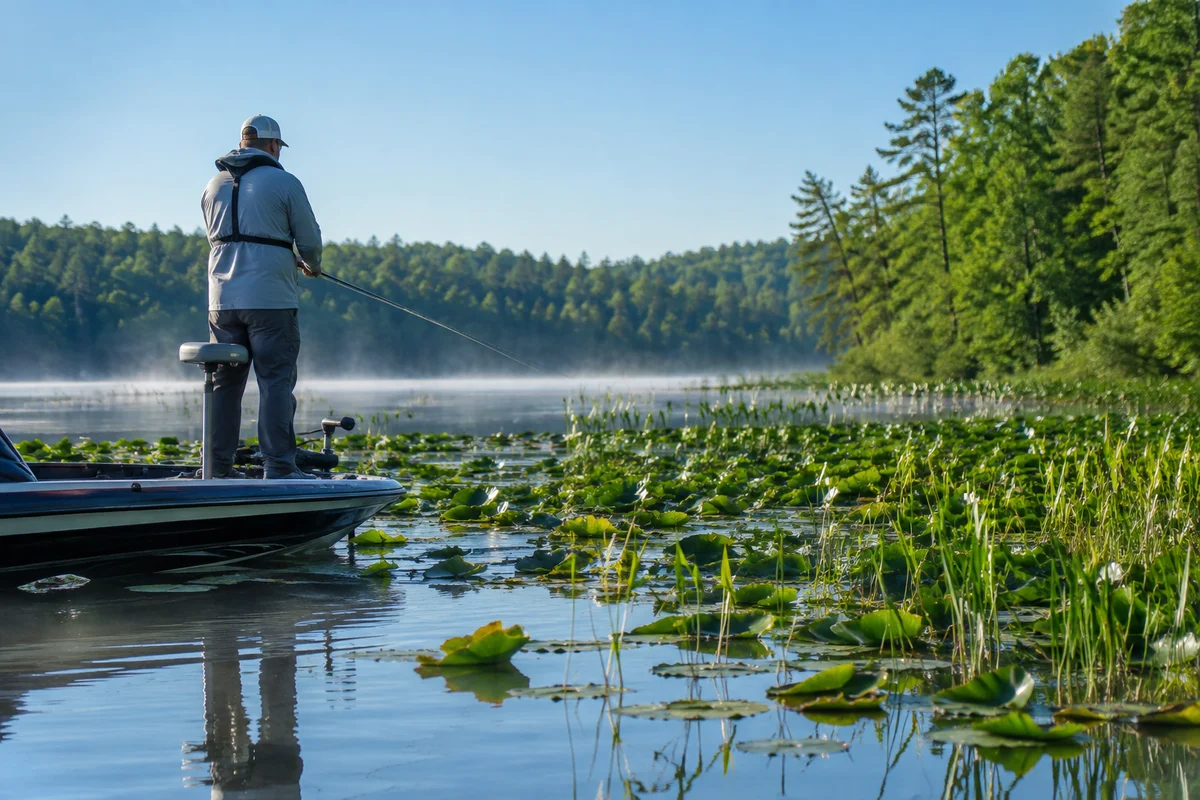
Weed beds can make a familiar lake feel like a different fishery: casts disappear into green cover, lures come back fouled, and a promising patch seems impossible to work. Fishing in the weeds becomes more productive when you treat vegetation as structure rather than a wall. Identify its edges and openings, make a deliberate presentation, and adjust to what the cover allows.
The word “weeds” covers many kinds of aquatic plants, from submerged grasses to floating leaves and emergent stems. Their shape, density, and seasonal condition affect where fish can move and where a lure can pass. No single lure or retrieve suits every bed. The useful starting point is observation: determine what kind of cover is present, where it meets open water, and which lanes are fishable without forcing a cast.
Why fish use aquatic vegetation
Plants can provide shade, ambush cover, and habitat for small aquatic animals. In turn, baitfish and other forage may gather near vegetation, attracting predators. But a thick bed is not automatically a productive spot. Fish may be along its outside edge, inside a pocket, beside a depth change, or elsewhere depending on conditions and the species in the water.
Light, wind, water level, temperature, and plant growth all change the picture. A sunny afternoon may make a shaded edge worth checking; wind can concentrate floating food or make one side of a bed more active. These are clues, not guarantees. Compare a few places rather than assuming a pattern from one cast.
For broader freshwater context and related techniques, browse the freshwater fishing tips hub. If you are fishing unfamiliar water, a fishfinder overview can help you think about what electronics can and cannot show; plants, bottom composition, and fish detection vary by equipment and conditions.
Read the bed before choosing a cast
Start from a position that lets you see the outline of the vegetation. Look for changes: a point that extends into open water, a notch, a narrow channel, a gap between clumps, or a transition from sparse to dense growth. These features create edges and routes through the cover. A uniform-looking field may still have subtle lanes, so scan from more than one angle when practical.
Then consider depth and access. A visible opening is useful only if you can present a lure there safely and retrieve it without dragging through an obstacle. Check wind direction and boat position, or choose a bank angle that gives you a clean approach. Avoid trampling shoreline plants or disturbing sensitive habitat simply to reach a cast.
A quick spot-selection framework
| What you see | First place to try | What to learn |
|---|---|---|
| A distinct outside edge | Cast parallel to the edge | Whether fish are following the boundary |
| A pocket or open lane | Work the opening and its corners | Whether fish are using an access route |
| Sparse plants beside dense growth | Target the transition | Whether fish favor the cover change |
| A point or isolated clump | Approach from open water | Whether the feature concentrates activity |
| Thick, continuous vegetation | Find a safer, cleaner edge or gap | Whether a different presentation is needed |
This is a starting framework, not a rule. Make a few controlled casts to each promising feature. If nothing happens, change the angle or move to another feature rather than repeatedly landing in the same spot.
Match the presentation to the cover
Choose a lure based on how much vegetation it must cross and how precisely you can place it. A lure that runs cleanly along an edge may be a poor choice for a dense mat. Conversely, a bulky or weed-resistant presentation can be awkward in a narrow opening. Consider hook exposure, lure profile, sink rate, and whether you can keep the retrieve in the intended lane.
In sparse cover, a moving lure can search an edge efficiently. In a pocket, a slower presentation may give fish time to find the offering. In dense vegetation, anglers often favor designs intended to pass through cover with fewer snags, but “weedless” does not mean snag-proof. Plant stems can still foul a lure, and a hook can catch vegetation on the retrieve.
Match tackle to the fishery and cover, not to a universal recipe. Use equipment appropriate for the expected species and local regulations, and avoid overpowering fish or leaving line and tackle in the environment. If you are comparing tackle topics, the guide to fishing spoons explains a different style of presentation that can be useful in more open lanes, while the tackle backpack overview offers ideas for organizing a small selection of tools and lures.
Make accurate casts and controlled retrieves
When possible, cast beyond the target and bring the lure into the opening or along the edge. This can keep the landing from startling fish in a small pocket and gives you control over the lure’s path. If the opening is tight, shorten the cast or change position rather than forcing an inaccurate throw into the thickest vegetation.
Retrieve at a pace that lets you feel or see what the lure is doing. If it catches a strand, pause and clear it gently when safe; continuing to drag a mass of plants usually changes the action and makes the next cast less informative. For a lure worked slowly, allow it to settle only where the depth and cover permit. Keep track of where it is, especially near submerged stems or snags.
A fish striking near vegetation can turn quickly toward cover. Keep a steady connection and guide the fish toward open water without yanking blindly. Use tackle suited to the species and local conditions, and handle any fish you release carefully. Wet hands, minimal time out of water, and support appropriate to the fish help reduce handling stress; follow local rules for seasons, limits, and release practices.
Troubleshoot common weed-bed problems
The lure returns covered in plants. Change the cast angle, target a thinner edge, or use a presentation better suited to that vegetation. Check the lure after each cast and remove plant fragments rather than repeatedly fishing with a fouled offering.
You see no activity. Try a different edge, pocket, or depth instead of assuming the whole bed is empty. Give a feature a few purposeful presentations, then move. Fish can be present without visibly feeding, and surface signs do not reveal everything beneath the plants.
You cannot tell what the cover is doing. Watch how the line moves and how the lure behaves, and use a clear view from shore or boat when available. Electronics may help describe depth or structure, but readings depend on the device, settings, and conditions; they should support, not replace, direct observation.
The wind makes precise casts difficult. Reposition if safe, cast with the wind when that improves control, or fish a more sheltered edge. Do not let the desire to reach a particular pocket override safe footing or boat handling.
A practical checklist for fishing in the weeds
Before the first cast, use this short routine:
- Identify the vegetation’s outside edge and any visible gaps, points, or transitions.
- Choose one feature and a cast angle that keeps the retrieve in open water or a clear lane.
- Match lure profile and hook exposure to the density of cover and the target species.
- Check the lure for fouling after each presentation; change angle or location if it repeatedly collects plants.
- Move after a few deliberate casts without a useful sign, and compare a different feature.
- Respect access, habitat, fishing seasons, and local restrictions; carry out discarded line and tackle.
Let conditions guide the next adjustment
Vegetation changes through the season as plants grow, thin, or die back, and the usable lanes may shift with water levels and weather. A place that was easy to fish earlier can become dense, while a newly opened edge may offer a clearer route. Reassess the cover each visit instead of relying on a remembered pattern.
The goal is not to force a lure through every patch. Find a readable feature, make a clean presentation, and use each retrieve to learn something about the water. That approach makes fishing in the weeds more orderly, reduces wasted casts, and helps you adapt when the bed—or the fish—does not behave as expected.
Frequently asked questions
Where should I cast when fishing around weeds?
Begin with the outside edge, a pocket, a point, or a transition between sparse and dense plants. Cast so the lure can travel through a clear lane.
What lure works best in thick weeds?
There is no universal choice. Match lure profile, hook exposure, and retrieve to plant density, the target species, and local conditions; weed-resistant designs can still snag.
Should I fish the edge or the middle of a weed bed?
Try both when the cover allows. Edges and openings are easier to target, while interior pockets may also hold fish; compare features rather than assuming one is always better.
How can I keep a lure from collecting weeds?
Adjust your cast angle and retrieve lane, choose a presentation suited to the cover, and check the lure after each cast. No design is completely snag-proof.
Sources & further information
Consult these primary sources for current regulations, technical information and local guidance.