How to Winterize a Boat: A Practical Seasonal Checklist
A careful winterization protects a boat from freeze damage, corrosion, and avoidable spring repairs. Use this system-by-system guide, then verify the details in your engine and equipment manuals or with a qualified marine technician.
Winterization is not one universal procedure: how to winterize a boat depends on its engine, plumbing, fuel system, and storage climate. The goal is to remove or protect water where freezing can cause damage, preserve components during months of inactivity, and leave the boat ready for a safe spring recommissioning. Start with the owner’s manuals for the boat, engine, generator, and onboard appliances; when instructions conflict or a system is unfamiliar, ask a qualified marine technician.
Make a list of every system that holds water, including the engine, freshwater plumbing, head, livewell, washdown pump, air conditioning, and raw-water-cooled equipment. A boat stored in a heated building may need a different plan from one left outdoors through repeated freezes. Don’t assume that draining one visible line protects hidden pumps, low points, or heat exchangers.
First, choose the right winterization plan
Before beginning, identify the propulsion type and cooling arrangement. Outboards, sterndrives, and inboards differ; so do raw-water-cooled and closed-cooling systems. A closed system still may have raw-water passages that require protection. Follow the manufacturer’s exact procedure for the specific model and year rather than relying on a generic video or a neighbor’s routine.
Check the forecast and storage location. If freezing weather can arrive before the boat is serviced, prioritize getting a professional appointment or moving the boat to appropriate protected storage. Winterization chemicals and antifreeze must be suitable for their intended system and used exactly as labeled. Automotive antifreeze is not a substitute for products and procedures specified for marine systems.
If you’re comparing hull styles or planning a future boat, our overviews of the Tracker Targa V-20 WT fishing boat and Tracker Deep V multi-species boats offer useful context about different freshwater fishing-boat layouts. They are not substitutes for the service manual for your own boat.
Boat winterization checklist at a glance
| System | What to verify | When to get help |
|---|---|---|
| Engine and cooling | Correct manufacturer procedure; water removed or protected in all required passages | Unsure of engine type, drain locations, or cooling design |
| Fuel | Stabilization and storage steps match engine and fuel-system guidance | Fuel-injection or treatment instructions are unclear |
| Freshwater and sanitation | Tanks, lines, pumps, fixtures, and appliances addressed | Hidden plumbing, water heater, or sanitation system is unfamiliar |
| Battery and electrical | Storage, charging, and isolation follow battery and boat guidance | Damaged, swollen, leaking, or unusually hot battery |
| Hull and equipment | Clean, dry, inspect, and secure covers and gear | Structural damage, corrosion, or uncertain lifting/storage support |
Treat the table as a planning aid, not a complete service specification. Record what you did and keep that note with the boat’s maintenance file.
Protect the engine and cooling system
Engine winterization is the step with the greatest potential for costly freeze damage. Consult the engine manual for its required sequence, whether it needs to run during service, and the correct way to protect its cooling passages. Don’t start an engine without the water supply and setup the manufacturer requires. Running dry can damage components quickly.
For an outboard, follow the model-specific directions for flushing, draining, storage position, and any corrosion-protection steps. For a sterndrive or inboard, determine whether the engine uses raw-water cooling, closed cooling, or a combination. A closed-cooling system does not mean every water passage is freeze-proof; the raw-water side may still need attention. Drain plugs, hoses, manifolds, heat exchangers, and pumps vary by design, so don’t guess at locations or assume a single drain empties the system.
If the procedure calls for marine antifreeze, use the product and method specified for that system, and check that it is appropriate for expected temperatures and materials. Never rely on color alone to identify fluid or prove adequate protection. A technician can confirm the correct approach and document service—especially valuable if the engine’s history is unknown.
Fuel, oil, and other engine care
Fuel guidance varies with the engine, fuel type, tank material, and storage duration. Follow the engine and fuel-system manufacturers’ recommendations on fuel stabilization, tank level, and whether the fuel should be treated or managed another way. Use only a compatible product as directed; adding more than the labeled amount is not a shortcut. If the boat has a water-separating filter, consult its manual about seasonal service and safe disposal of drained material.
Complete any oil and filter changes or corrosion-prevention steps the manufacturer recommends for off-season storage. Check the gear lubricant or drive fluids if specified, and investigate signs of water contamination, leaks, or metal debris instead of simply storing the boat and hoping they resolve themselves. Don’t mix fluids based on appearance; verify specifications in the service information.
Drain and protect freshwater and sanitation systems
Freshwater systems can hide water in pumps, filters, faucets, heaters, and low sections of hose. Empty the tank as directed, then address each branch and appliance according to its own manual. Include the galley, shower, washdown system, transom shower, ice maker, and any water-using appliance. A drained tank alone does not mean the entire system is empty.
For a marine head and holding system, use the manufacturer’s winter-storage directions and local rules for handling and disposing of waste. Don’t discharge untreated sewage where prohibited. If a system has a macerator, treatment unit, or complex valve arrangement, get model-specific guidance rather than improvising.
Use only antifreeze labeled for the intended potable-water or marine sanitation application, as appropriate, and follow its label and equipment instructions. Keep products separate and clearly identified. If you cannot confidently trace a system from intake to outlet, a marine service professional can help prevent both freeze damage and contamination.
Battery, electronics, and onboard equipment
Turn off and isolate electrical equipment using the boat and battery manufacturers’ procedures. Battery care differs by chemistry and charger, so check both manuals before disconnecting, charging, or storing it. Keep batteries in a suitable, ventilated location and use only a compatible charger. Do not charge a damaged or suspect battery; seek qualified advice.
Remove portable electronics and valuables if practical. For installed electronics, follow the maker’s recommendations for power isolation and storage. Check bilge-pump operation and ensure automatic protection remains configured as intended for the boat’s storage conditions. Never disable a safety system without understanding the consequences, and don’t leave shore power connected unless the installation and monitoring plan are safe and appropriate.
Clean, inspect, and prepare the boat for storage
Wash off salt, mud, plant material, and other residue, following the care instructions for the hull and finishes. A clean hull is easier to inspect; see our guide to cleaning a boat hull for general care considerations. Remove food, damp gear, and items that can mildew, freeze, attract pests, or damage interior surfaces. Let compartments dry, then use ventilation and a cover arrangement that sheds water without trapping excessive moisture.
Inspect the hull, transom, steering, propeller, trailer, and visible hoses for damage or corrosion. Make a repair list for spring rather than treating a winter inspection as a substitute for maintenance. Secure loose equipment, protect exposed openings as the manufacturer recommends, and check that the boat is supported by equipment designed for its weight and shape. If hauled out, follow the yard’s instructions for blocking and access; never work beneath an inadequately supported boat.
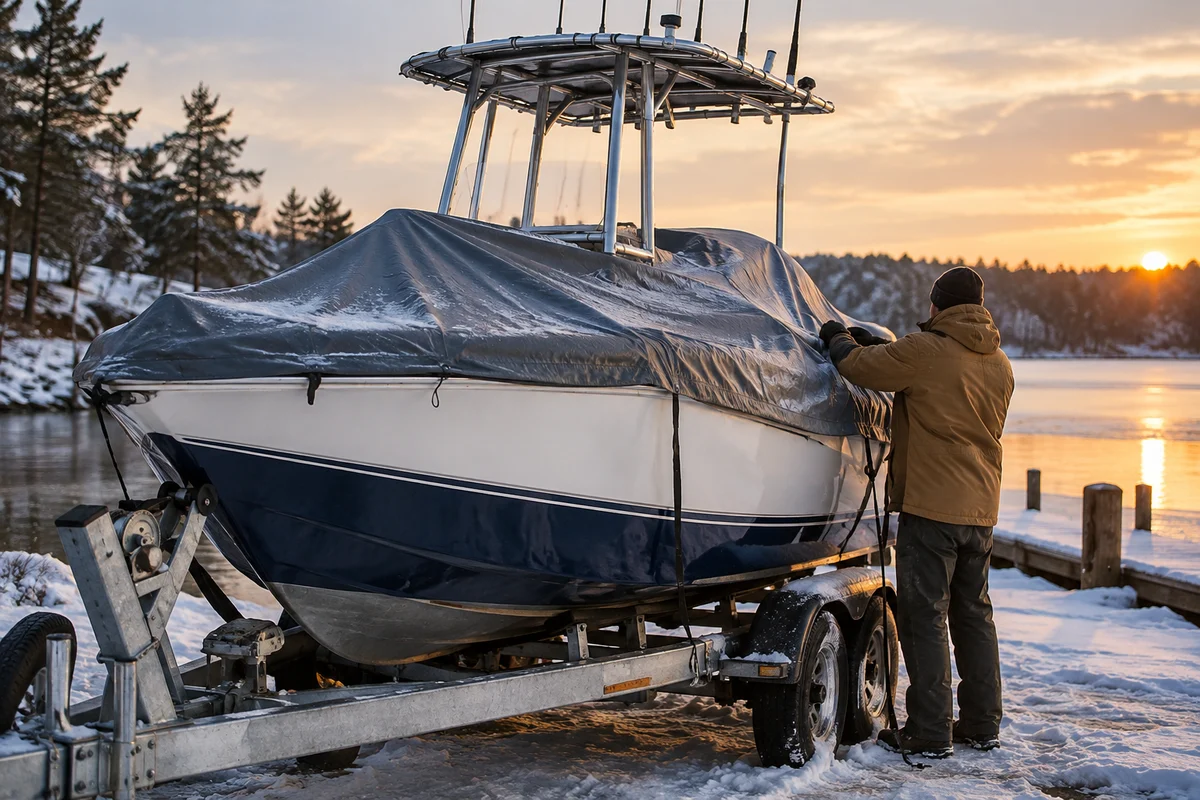
A cover should resist weather while allowing suitable ventilation. Avoid arrangements that pool water, chafe finishes, or place loads on rails and fittings not designed to carry them. Check the boat periodically during storage, especially after storms or heavy snow, and clear accumulated loads safely.
A simple decision framework: do it yourself or hire a technician?
A confident owner can handle familiar, manual-documented tasks with the correct tools and safe workspace. Hire a professional when the engine cooling arrangement is unclear, the boat has multiple water-using systems, service history is missing, a leak or contamination is present, or the manufacturer requires specialized equipment. If temperatures are already near freezing and the boat is not protected, call a local marine service provider promptly rather than rushing through uncertain steps.
Ask the shop to identify the work performed and any fluids or parts used, and retain the invoice. That record helps with spring commissioning and future service. The same careful approach applies to small craft and accessories; our piece on using a drift sock in a kayak covers a different kind of boating preparation, but highlights why gear-specific instructions matter.
Spring recommissioning belongs on the plan
Winterization is only half the seasonal routine. Before launching, inspect the hull and systems, restore batteries and equipment as directed, check fluid levels, verify cooling-water flow, and test steering, controls, bilge pumps, navigation lights, and safety equipment. Follow the manufacturer’s startup checklist and address unusual noises, leaks, alarms, or odors before heading out. If a professional winterized the boat, ask what was disconnected or left tagged for spring.
The safest winter plan is specific, written down, and matched to the actual boat—not copied from a different engine or climate. Use official manuals, protect every water-holding system, and get experienced help where uncertainty remains. Those habits reduce preventable damage and make the first trip of the next season more predictable.
For more, explore our boat news guides.
Frequently asked questions
When should I winterize my boat?
Before freezing temperatures can reach the boat or its water-filled systems. Timing depends on local weather, storage conditions, and service availability.
Can I winterize my boat myself?
Yes, if you can identify every system and follow the exact boat, engine, and equipment manuals. Hire a marine technician if cooling or plumbing procedures are unclear.
Does a closed-cooling engine need winterization?
Often, yes. Closed cooling may protect part of the engine, while raw-water passages and connected equipment can still require draining or protection. Verify the model-specific procedure.
Can I use automotive antifreeze in a boat?
Do not assume it is suitable. Use only products specified for the particular marine or potable-water system and follow the manufacturer’s instructions and product label.
Sources & further information
Consult these primary sources for current regulations, technical information and local guidance.