Turkey Hunting Strategies for Pressured Birds and Changing Conditions
Successful turkey hunting is less about repeating a favorite setup than responding to what the bird, terrain, and season are telling you. Use this field guide to choose when to call, when to move, and when to back off.

Turkey hunting strategies work best when they begin with observation, not a call sequence. A gobble can reveal a bird’s location and mood, but it does not promise that the bird will travel to you. Terrain, other hunters, breeding behavior, and pressure all shape what happens next. A flexible plan—grounded in scouting, safe positioning, and patience—helps you make better decisions without treating any one tactic as a guarantee.
Start with information, not noise
Before the season, learn the access rules, season dates, legal hours, and permitted methods for the place you intend to hunt. Regulations differ among states and can change between seasons. Check the relevant state wildlife agency’s current rules rather than relying on an old article, a forum post, or a friend’s recollection. The National Wild Turkey Federation’s conservation and hunting resources can provide broader background, but local regulations remain the authority.
Scout from a distance where possible. Listen for birds at dawn, note where they fly down, and look for tracks, droppings, scratching, feathers, and dusting areas. Sign indicates use, not necessarily a bird’s current position. A map can help you identify ridgelines, creek bottoms, field edges, and likely travel corridors, but verify access and boundaries on the ground. Mark safe routes in and out, including a plan for encountering other hunters.
A short, accurate note is more valuable than a complicated prediction: date and time, wind, weather, location, observed behavior, and whether the bird was heard or seen. Patterns can guide your next visit, but wild turkeys change routines. Treat yesterday’s roost or travel route as a clue rather than a promise.
Set up where the bird can arrive naturally
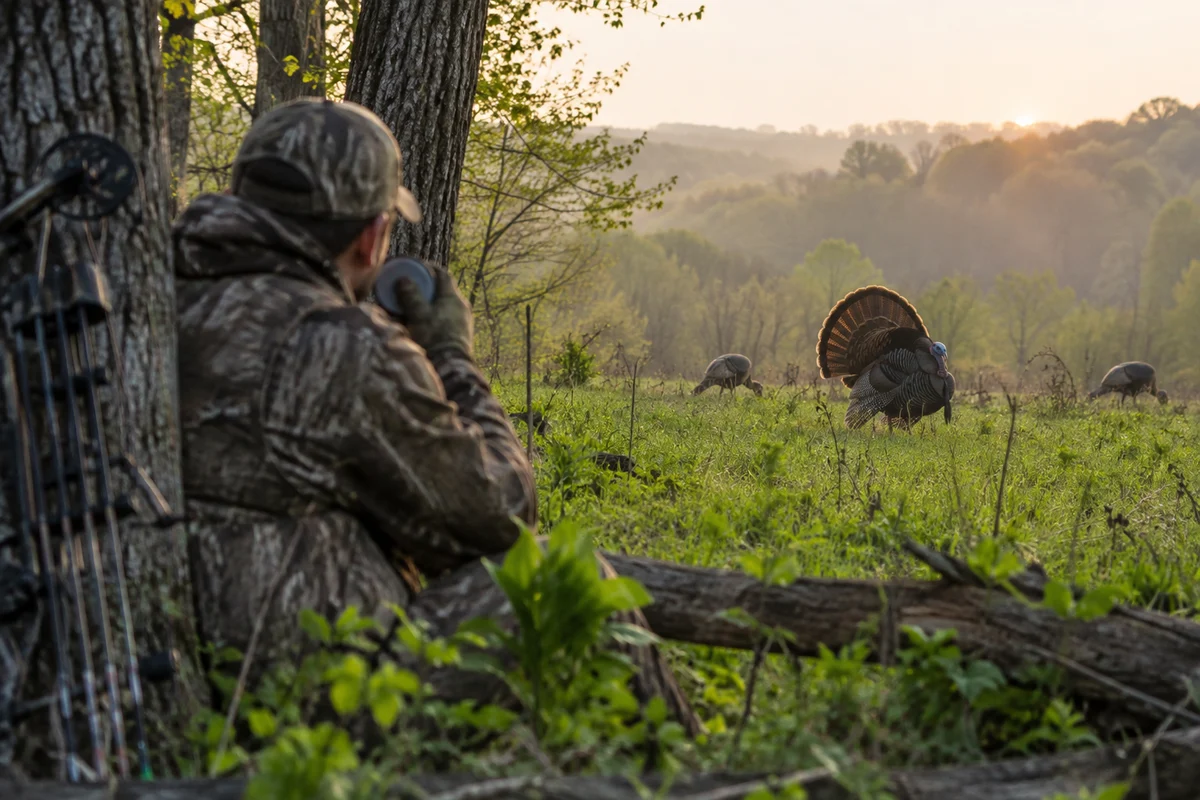
A good setup balances three things: a plausible route for the turkey, a clear view of the approach, and a safe background. Choose a stable position before calling. Sit with your back against a broad tree or another solid natural backdrop, keep your outline broken up, and avoid placing yourself where a person approaching from another direction could mistake you for a bird. Never wear red, white, or blue while turkey hunting; these colors can resemble parts of a gobbler’s head. Identify every target and what lies beyond it before considering a shot.
Think about how the terrain channels movement. A bird on a ridge may follow the crest or skirt a steep drop. A creek, fence, thick cover, or a field edge can influence its route, but none is an absolute barrier. Do not assume a gobbler will cross an open area simply because a decoy is there. If a bird is on the far side of an obstacle, consider whether it has a comfortable route around it and whether you can reposition without crossing its likely path.
Decoys are optional tools, not requirements. Their usefulness depends on visibility, pressure, local rules, and the bird’s behavior. In thick cover or where other hunters may be present, a decoy can create safety concerns and may be less useful than a concealed, well-chosen setup. If you use one, place it where you can see the approach and retrieve it safely. Learn how to choose a turkey call based on conditions and your ability to use it consistently; realistic calling is not the same as constant calling.
Choose a response to the bird’s behavior
A gobbling bird gives you information, but the right response depends on more than distance. Is it moving toward you, holding in place, or answering from the same spot? Can you reach a position without being seen? Is another hunter likely to be between you and the bird? A calm decision often beats a quick move.
| What you observe | A measured response | What to avoid |
|---|---|---|
| A bird answers from a known direction and remains distant | Set up along a safe, plausible travel route; use a restrained call and wait | Calling repeatedly just to make it answer |
| The bird is approaching or appears nearby | Stop moving, keep still, and let the bird close the distance | Standing, turning, or making a sudden sound |
| The bird answers but does not come closer | Wait, reassess terrain and pressure, then consider a modest reposition only if safe | Chasing every gobble through uncertain cover |
| A bird goes quiet after fly-down | Stay alert; it may be moving silently, tending hens, or simply out of hearing | Assuming silence means the bird left |
| You cannot identify the bird or background clearly | Do not take a shot; wait for a safe, certain opportunity or end the encounter | Shooting at movement, sound, or a partially obscured target |
Calling volume and frequency should match the setting. In open country, a bird may need to hear a call across distance; in tight woods, a quiet sound can carry. If a gobbler answers but stays put, consider whether it is with hens, separated by terrain, or responding from a protected area. A pause gives you time to observe and prevents your calling from obscuring other sounds. Some days the best call is no call.
When to move—and when to back off
Movement can improve your position, but it can also end a hunt or create a hazardous encounter. Move only when you have a clear route, know where the bird is, and can avoid crossing another hunter’s line of sight. Keep your firearm pointed in a safe direction and follow the manufacturer’s safety guidance and your state’s rules. If visibility is poor, the bird’s location is uncertain, or another hunter may be nearby, remain still or leave the area safely rather than trying to close the distance.
Back off when the bird appears alarmed, when repeated approaches have made the area feel pressured, or when your route would expose you. Leaving a bird alone can preserve the chance of a better encounter later. On public land, be willing to abandon a spot if you hear another hunter calling or see signs of someone already set up. Call out clearly in a calm voice if you need to identify yourself; never use a turkey call to communicate with another person.
A change in weather also calls for adjustment rather than certainty. Wind can make calls harder to hear, and rain may alter where birds move or how well you can observe them. Seek a position with a safe view and enough shelter to remain comfortable, but do not force a shot through poor visibility. If conditions make it difficult to identify a bird, wait or stop hunting until they improve.
Build a simple decision framework
Use this sequence whenever a hunt stalls:
- Confirm safety. Know your target, background, legal shooting conditions, and the location of other people as far as you can determine.
- Read the evidence. Separate what you saw from what you inferred. A gobble provides a direction and moment in time—not a guarantee of location now.
- Check the route. Look for a safe, quiet approach that does not cross the bird’s likely path or another hunter’s position.
- Choose one adjustment. Wait longer, reduce calling, shift a short distance, or leave. Changing several variables at once makes it harder to learn from the result.
- Reassess honestly. If the bird remains out of reach, end the setup without rushing. A safe, unfilled hunt is better than an unsafe shot.
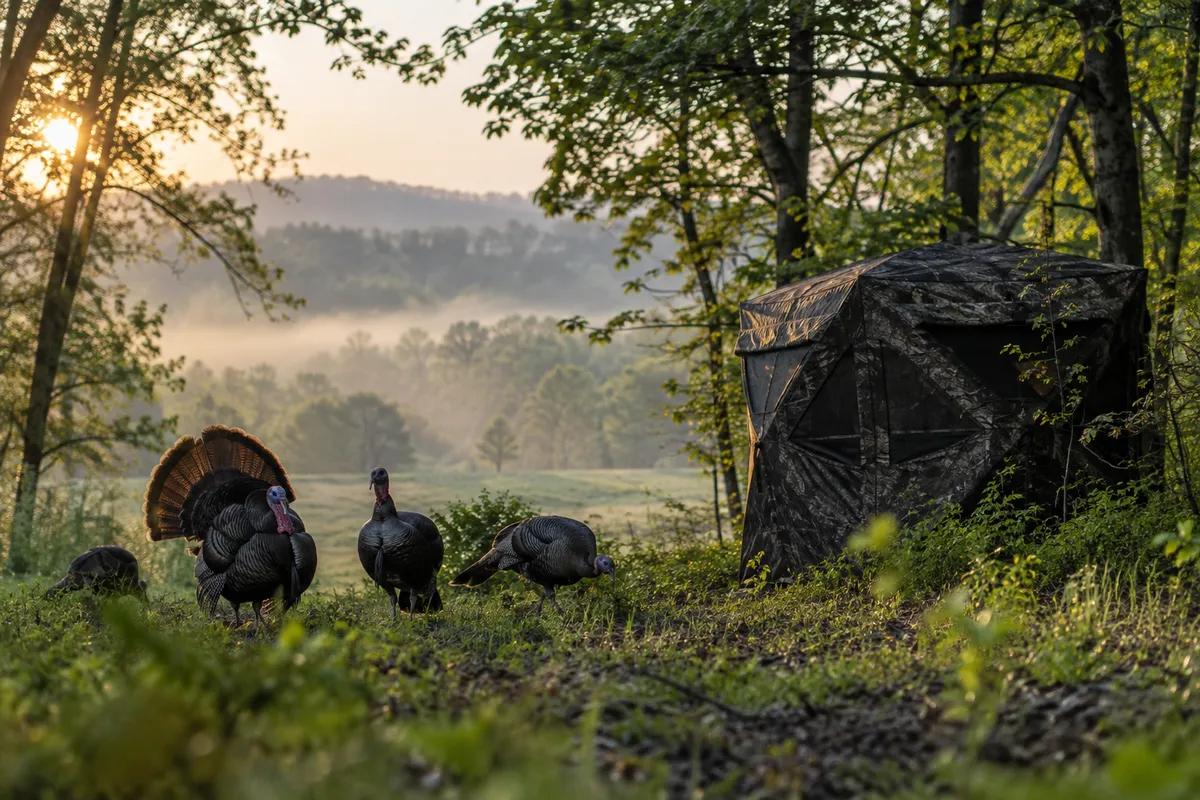
Equipment should support this plan. Wear suitable camouflage for the habitat, but remember that concealment does not replace safe positioning. Carry water, weather layers, navigation, and a charged communication device where service permits. If you use a blind, make sure it does not restrict your view or safe handling, and follow the product instructions. For a deeper look at one style of concealment, see this overview of the Blackout X300 ground blind; its suitability depends on the site and the hunter, not a universal advantage.
Keep safety and stewardship central
Turkey hunting often takes place in shared landscapes. Respect property boundaries, follow access rules, and avoid disturbing roost areas unnecessarily. Pack out litter and retrieve equipment without creating a disturbance or unsafe situation. Safe firearm handling is essential: treat every firearm as loaded, keep the muzzle pointed in a safe direction, keep your finger outside the trigger guard until ready to shoot, and identify the target and what is beyond it. Store firearms securely when not in use, especially around children and unauthorized users. Review current state laws and hunter-safety guidance before each season.
There is no universal recipe for a gobbler that will not cooperate. The most dependable turkey hunting strategies combine careful scouting, a safe setup, restrained decisions, and a willingness to adapt. Listen closely, make each move for a reason, and let the conditions—not impatience—decide when it is time to wait, reposition, or back off.
For more, explore our turkey hunting guides.
Frequently asked questions
How often should I call to a turkey?
There is no fixed schedule. Match volume and frequency to terrain and the bird’s response, then allow quiet periods so you can listen and avoid overcalling.
What should I do if a gobbler answers but will not come closer?
Stay patient and consider terrain, hens, and hunting pressure. If you can reposition safely without crossing the bird’s route or another hunter’s position, make one modest adjustment; otherwise wait or leave.
Is it safe to move toward a gobbling turkey?
Only if you can identify your surroundings, maintain a safe route, and avoid approaching another hunter. Never move toward a sound alone when the bird’s location or other people’s positions are uncertain.
Do I need a decoy for turkey hunting?
No. Decoys are optional, and their usefulness varies with visibility, pressure, regulations, and the bird’s behavior. A safe setup and sound judgment matter more.
Sources & further information
Consult these primary sources for current regulations, technical information and local guidance.